For most coaches session planning is the bane of their existence.
No doubt that they require time and effort. A hallmark of most of what is worthwhile in the world. The effort aspect for most is not a problem, time can be.
Human beings will find time for the things that they enjoy and push back the those that they do not. Equally they will find time for the things that must be done and push aside those that it would be good to do. With the plethora of session plans available to purchase or pick up for free on various forms of media the life of the coach has been made easier and planning is pushed aside.
There is a problem here. No plan is going to be plug and play because that plan was not designed for your players.
As a provider of plans myself it can’t make any sense to be suggesting that the often excellent plans available are of no use. They absolutely are, but not without adaptation. You know your players, the person making those plans very likely does not.
They will not know your context. All planning must start with context. This will dictate the levels of detail required, the levels of intervention from the coach, how the information is relayed to the players, even how finite the outcomes for the session might be.
As there are so many factors involved in coaching the words “may”, “might” and “could” (plus other similes) will appear with regularity. There are no guarantees that any one thing will work in the manner intended due to the infinite possible variables.
Question – How old are the players?
Question – What is the competence of the players?
Question – What gender are the players?
If I am planning I would start with these questions before looking into anything else. The answers can be very straight forward.
The players are development centre under 12s.
This answer gives us an idea that they are not beginners and are likely to play an amount of football elsewhere, thus making our session a part of their playing patchwork.
The players are mixed gender grassroots under 9s.
This answer tells us that there could be a large variability in their abilities and experiences. We will need to make sure that we plan in opportunities for all players of different ability levels to have success and also to be stretched.
The players are male under 15s getting ready for the London Youth Games.
These players may be of mixed ability until the selection is made. The first session or two will be run as trials from then on we have a fixed target in mind, preparing for a tournament with players who have a high level of football experience.
The players are adult females playing grassroots football.
The players within the group could have big differences in football experience. A balance will need to be found between having fun and winning.
A balance between having fun and winning. This will feature across every plan we make, no matter the levels of detail.
Players will fit into different stages of and levels of their context. All players under 10 will be in a sampling stage wherein they are getting a taste of the game. It might even be argued that until players start playing 11v11 they are still in a sampling stage because the game they play does not fully conform to “the real game”. Other versions of football (futsal, panna, beach football and others) may go beyond the sampling stage and into the participation stage earlier than football because they play the full version of their game earlier in their development. This is neither better or worse, just different.
Within the participation stage players are doing just that, participating. This may be because the main objective of their football experience is social or because they are still along a developmental journey. The participation stage is certainly not age specific though age may play a part.
The players on a developmental journey may move from participation into performance. The age at which this happens is without any doubt a source of debate but the coach of the group should have an understanding of whether or not the players are in a performance environment.
Finally we will have the elite performer. The definition of whether someone is an elite performer or not may also differ from person to person. We need to consider how often they train, are they paid to perform, are they expected to win, does an aspect of their future success depend on whether they win or not, do they perform on a national or international stage?
Planning a session for a player or group of players in the sampling stage has to look very different to the plan for an elite performer. The expectations of the player and the coach should also be different. Hopefully it will also be different for the concerned others (parents, peers, partners etc). There will be times when a group of players are in between stages, neither clear cut as being participant or performer (for example), but a little of both. This is not necessarily a problem as long as all involved understand this (the understanding may not need to be explicit, particularly between younger players and coach). Everything will flow more easily if the expectations of all involved are aligned. Also remembering that even elite performers like to have fun.
After considering these factors we can then get a feel for the needs of the group. This should be one of the key drivers behind our plans alongside the needs of the individuals.
When delivering a first session with a group it can be very difficult, nigh impossible, to have a handle on the needs of individuals. How can you? You do not know them. The first few sessions may in essence be fact finding missions where the nuances of the individuals are discovered, be they technical, tactical, physical, psychological or social. As coaches we need to know who they are and show the players that we are getting to know who they are, from here we can develop an environment of trust and work together with a warm closeness rather than a cold distance.
It should be noted that a few coaches may work in a setting where reports of player progress and competencies are maintained. In such settings those reports can be passed on to the coach of a new group, giving that coach a small head start, but that will not be as impactful as taking the time to gain the knowledge of individual players.
How the coach uses this knowledge will then depend on context or the style of the coach. If a coach has been working with a group for many seasons the understanding of the individual may be ingrained. The coach may not need to write it down in any way. However, for some the understanding may be ingrained yet they still feel the need to document it and use it in some form. The opposite could also be true, that a coach does not know a group well so feels the need to document observations. Another coach may not work in this way and be very good at sizing up individuals, retaining and using individual without the need for documentation. Either way, the knowledge of individuals will impact practice design.
A further model could be that players display cognition or even metacognition, providing information to the coach about their needs (cognition) or even being able to pinpoint how they can get what they need within a practice (metacognition). The age and experience of players is factor in these abilities but most coaches will have met young players who can tell them exactly and precisely what they need to improve and how to do it while also meeting older players who struggle to comprehend their own game. The environment in which they have developed could be a crucial factor, if the environment has not been one that allowed the player to think for themselves, they may have difficulties doing so later. It may also be that their environment showed them that their was no value attached to their thoughts and opinions, thus discouraging them from forming them.
My preference is for written notes that I can use. The four corner model makes a big impact here.
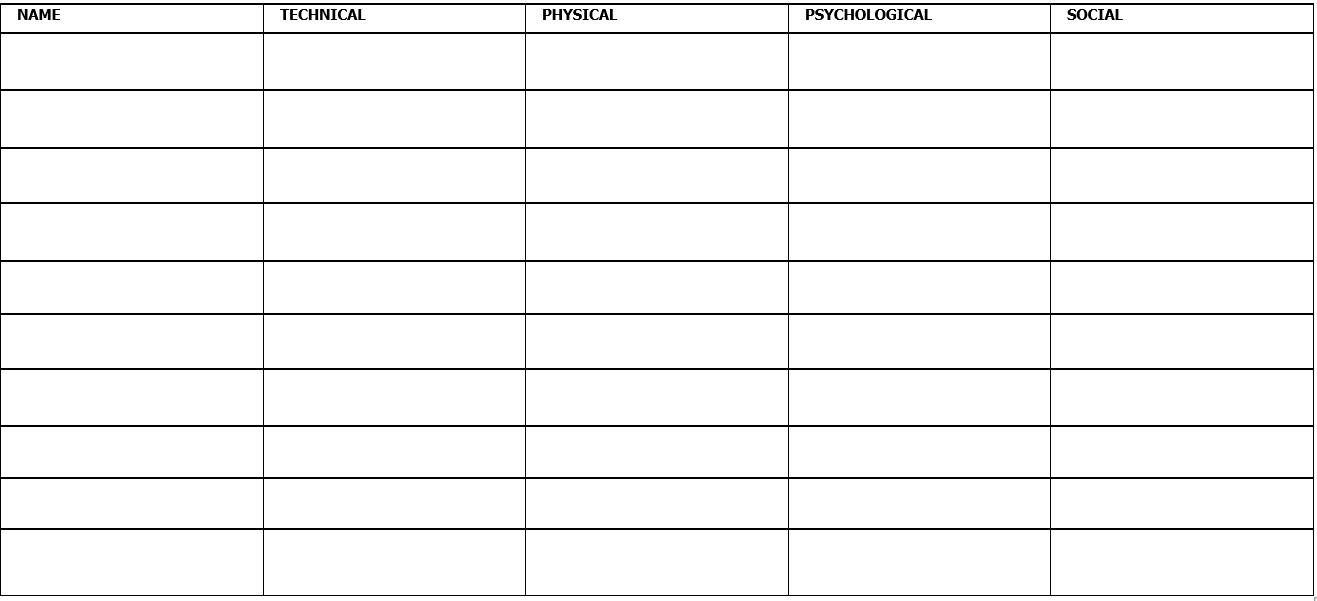
With guidelines in place for particular players I am able to build their needs into a session plan. Or their needs may be able to drive the plan itself. For example, with a team of under 15s we might identify that three players need help to improve their ability to hold a defensive line. Therefore the practice design can focus on the unit using a defensive line with these three players being focused on. When operating in such a manner it is important to tell the players that this is happening, otherwise they may feel the attention is unwelcome. Even after being told they may still find the attention unwelcome, in which case the strategy may need to be left for another day to avoid damaging the relationship with the player. It could be that the best thing a coach could do for player in a particular moment is to leave that player alone.
An even braver approach for the player and coach is to make one specific individual the focus of the whole session. If doing so there needs to be an understanding that all players will be treated equally and afforded the same opportunity in future sessions. Within a session where one individual is the focus it is likely that we may miss events, but, it is worth keeping in mind that very often by trying to see everything, we end up seeing nothing.
We have considered the context of the group and the needs of individuals we also need to be aware of some broader context.
For the players, what number session of the week is this one?
Depending on the player’s stage this might be their third session of the week, or their one and only session of the week. This will impact what you impart into the session and what the players are looking for. For a player who this is their only session of the week it is highly likely that they are absolutely itching to play the game. For a player on session three with a game upcoming it might be more appropriate to take part in lower intensity technical practice.
What number session of the season is it?
Fashionably known as periodisation. Depending on context this may or may not be significant. If the session is at the start of the season with a new group we may be exploring to lean about the group or striving for a balance between developing fitness and developing understanding of new tactics (adults). If the session is at the end of the season we may be winding down or having low intensity practices because of fixture build up. It might be that the intensity is cranked up for one final push.
What happened in the game before?
With young players this is more than likely to be irrelevant. It might be irrelevant to older players if our planning is dominated by periodisation. For many adults it will be that what happened in the last fixture will drive their choice of what they work on it training. The urge to correct perceived flaws is strong.
What are their fitness levels (and is fitness important to this group?)?
Particularly relevant to preseason or when taking over a new group. In grassroots or semi-professional adult level the fitness levels could vary wildly between players given that some will be better at looking after themselves than others. Thus, fitness work becomes more important. Fitness does not necessarily mean purely running. Fitness work can be combined with technical and tactical elements with smart planning.
For younger players the aspect of fitness within a football session should be largely irrelevant. No matter the players age they are going to want to play football at a football session.
Do they play elsewhere?
With our young players it is important to be aware that our football session with them is likely to form only one part of a large patchwork of sports sessions. School sports, school PE, other invasion games, other contact sports and so forth are all a part of the equation. If our session comes at the end of a week where they have had all of these things going on, should we be surprised if sometimes kids are not at their best in high intensity practices? For adults we might have a similar situation. They might be joining us for a Thursday night futsal session but have had an 11v11 game on Monday and football training on Wednesday. This player might not be at their peak level when making recovery runs.
What have they been doing this week (or even month)?
Imagine this is the first session back after Christmas or Easter break. Imagine that the player has just come back from a family holiday. Imagine they have been away on a football tour. In such circumstances what type of session would be best for their first week back? It might be that this question effects the whole group (Christmas, football tour) or it might effect an individual (holiday) but being aware of it can only help.
Are there any personal circumstances we should be aware of?
This question could be perceived as the more negative side of the above and range from children moving to a new school to a child being bullied, or even abused. The range of possibilities is sadly endless for children and adults. Divorce, bereavement, moving home, exams, injury, living in a foreign country, the list would be huge. For all the times when people say that they aren’t doing much, there is likely to always be something going on, it just isn’t “new”. If we have a relationship of trust we may be able to help the individual but we may also be able to accommodate their needs in our sessions.
Circumstances may effect numbers at the sessions which alters planning. The player might attend but be a long way off their best. To expect individuals to operate outside of their life circumstances within our practices is unfair and unrealistic. It may also be unrealistic to tailor everything to everyone but if we can be aware of the circumstances, demands, expectations and mind set we may be able to make some minor adjustments to help.
Context and circumstance are far reaching and many coaches will make unconscious decisions around them. At times it can be useful to make conscious decisions to help our planning.
Once we understand all of this, we can then start designing the practice.
Peter Thornton
15 Jun 2019Terrific read
This should resonate with any coach at any level