Questions and Deliberate Limitations/Radical Constraints
These are not new to sports coaches. The average modern (post 2005) coaching course will encourage the asking of open questions to encourage players to think. Often coaches will ask questions with a specific answer in mind, just as they will have designed the session with a specific outcome in mind. The players need to be free to answer, to come up with their own solution, even if it differs from that of the coach.
Coaches have been using deliberate limitations for years. One and two touch passing practices will have been a common experience for any player or coach involved in football. There is much more scope to this area. Beyond needing to score with a one touch finish, x number of passes equals a goal or playing with your weak foot only. Especially when combined with the word Radical and with a little contrarian thinking sprinkled in. Our only limitation is what we can think of, the outcome we are aiming for is the spark of creativity, thus the phrase “realistic to the game” is less relevant.
- Move the goals. They can face the wrong way, be placed in the corners, be back to back in the middle of the pitch, the list goes on. The players will have to think of different ways to attack and different ways to score. Their perception of the game has to alter.
- Change the shape of the pitch. What happens when the pitch is narrow and long? Or when the pitch is wide but short? Further than this, change the shape entirely. A square. A triangle. A diamond. A circle. How will the players have to play in such a shape? How will they perceive space? Where do the goals go?
- Change the scoring system. The “x number of passes equals a goal” style of practice hints at this. Yet we can get more creative. Different types of goal equal different points. If we are looking for creative dribblers then moves in game might equal points. Even better if the players set the types of move/dribble and the point weighting.
- Add zones/areas/targets. There are never ending possibilities here when it comes to constraints. Pass to outside target players before scoring (wide players, touch line players, floating players). Play through a gate before scoring, the ball must pass through a certain zone (magic square), play through the thirds, only score from inside/outside the area. In this regard, it is the constraints we place upon training that differentiate between a “practice” and a “game”.
Contrarian Experimentation and Outsider Thinking
Outsiders are vitally important to progress. Though our years of experience are of immense value they can close us off to the new. To the unrealistic. What may be unrealistic can still be relevant. The creative ideas and methods used need to be directed towards football otherwise we get no buy in. Simply, without the correct framework, there are certain ideas that the under 8s will engage with but the under 16s will reject instantly.
Nicola Gaughan suggested asking “What would it be like to play football on the moon?”. I didn’t ask the under 8s exactly this question. I asked “What would it be like to dribble on the moon”. They gave back bountiful ideas before attempting to recreate it. The overflow from this was perhaps more beneficial.
“Can we try dribbling underwater?”
“What about in the desert?”
“On the motorway!”
Each location prompted different tasks. Dodging a cactus, being chased by a shark, dribbling through traffic. The practice did not belong to me, it belonged, wholly to the under 8s. From one question.
Gita Langston put forward similar questions.
- How would you play football if you were playing in a swimming pool? (I assumed that the pool was filled with water)
- How would you play football if the ball was made out of feathers?
- How would you play football if you were wearing high heels? Or concrete boots? Or dressed as a football?
Gita suggested a number of thought exercises and questions to apply to the game.
- How would you make sure your goal missed?
- What would your rules be for football if there weren’t any?
- Imagine that your game of football was a pizza. What would you put on it and why?
- If an alien landed and you were the only person left on Earth how would you describe football and how to play it?
- How would you convince your friends and family that football is a really bad game?
Both Gita and Nicola made a similar suggestion when taking into account that the tasks are for children.
- If you were picking a team of film stars/actors/musicians/Disney characters/other sports people/etc who would you pick and why?
- How would Beyonce/Darwin/Peppa Pig/(select well known person/character) play football? Why would they be good? Why would they be bad?
As an experiment I put out a tweet to see how this would work with notoriously cynical adults.
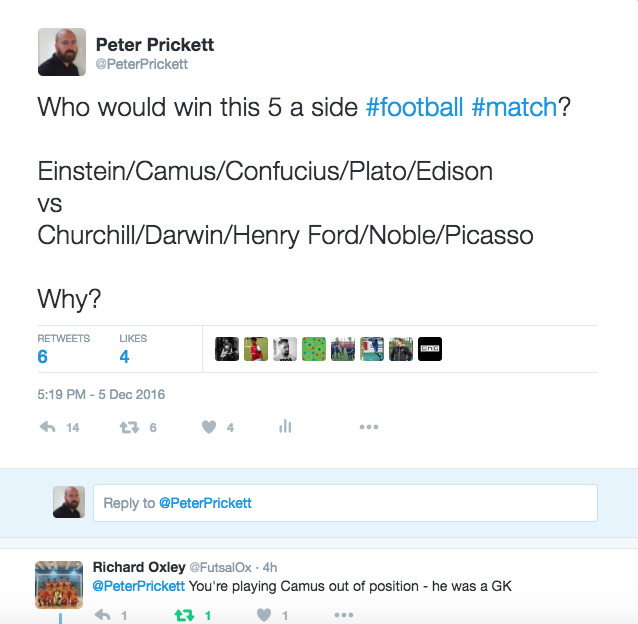
The responses were mixed, some jokey, some serious but the important factor was that people were thinking.
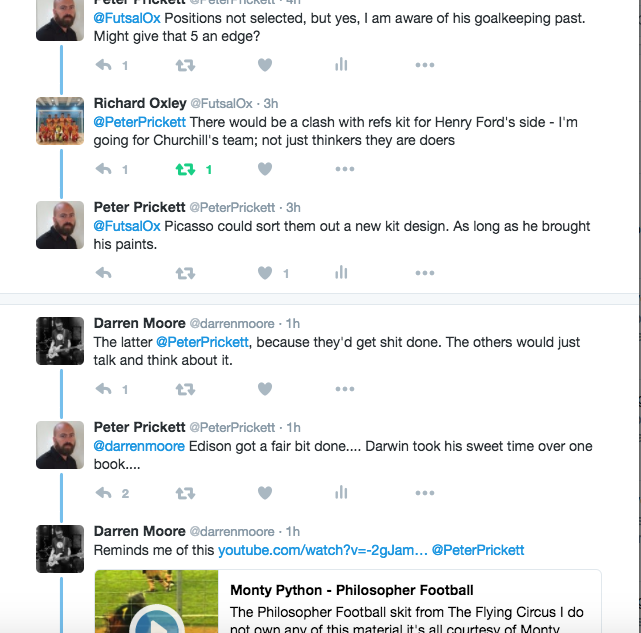
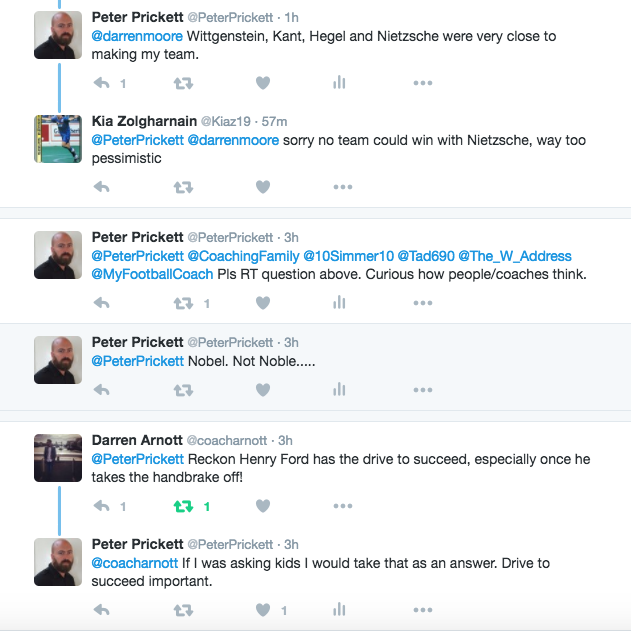
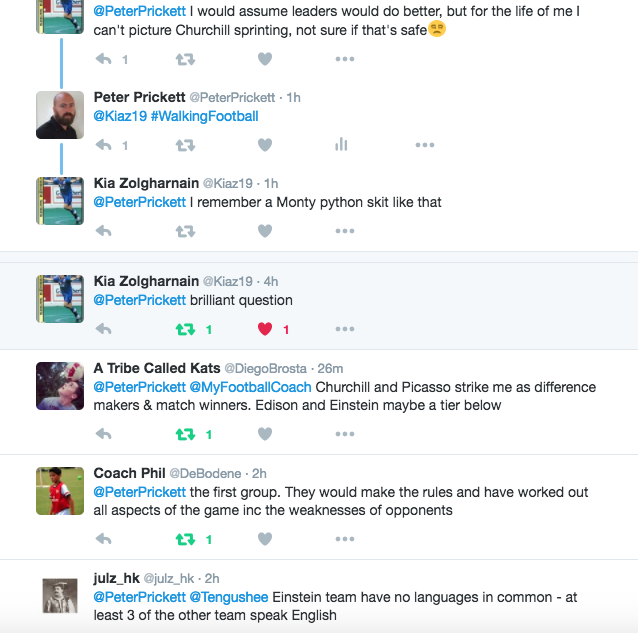
Other selection variations might be a 5 a side team of Kanye West, Jay Z, Dizzee Rascal, Eminem and Dr Dre or Ferrari, Lamborghini, BMW, Bugatti and McLaren. We would then ask the players to perform as they perceive the line ups, in the example used on Twitter leadership came to the fore, so the question has created a situation of communication and leadership, something I did not expect when I (semi) randomly put names together. With no fixed outcome a session would have developed.
From these suggestions we can produce our own contrarian ideas and questions, utilising our knowledge as coaches and then actually implement them. Reversing questions can also be an extremely powerful tool to utilise.
- What happens if we change the size/shape/weight of the ball? If we play with a tennis ball? Or a rugby ball?
- Give the players the options of removing certain rules from the game. Or changing rules. To practice corners without having relentless and monotonous repetition we can have every restart as a corner. If we are looking for greater discipline from a team every foul might be a penalty.
- Think of the most boring game of football. How can you make sure you never play in a boring match?
- Where could you stand that would mean you never score a goal?
- What could you do that means your team never wins a game?
- How can you make sure you concede lots of goals?
- What would make all your passes bad?
- Remove one rule from the game. What does the game now look like?
The idea of contrarian thinking links with the idea of giving players a run in every position as some point in their development. Some coaches believe in playing them in similar roles (Left back at centre back or left wing) however, if a centre forward plays as a central defender he will understand what defenders dislike and hopefully learn from that.
Creative Prompts and Freeform Capture
Young players are highly susceptible to external stimulus. Given the correct stimulus they will take an idea and run with it. Taking it into unexpected places. Generally children are better at this than adults. Just as children seem to be more naturally tuned into new technology.
Technology is our first bridge into creative prompts and will be the most likely source of the players freeform capture resources. By using videos at training we can give players ideas and inspiration. Goals that have been scored, imaginative set pieces or passes that open up defences that others have used can serve as inspiration, particularly if the examples come from well known, respected players. Many players look to the F2 Freestylers and have learned more tricks and moves from their videos than multitude coaches. This is their free form capture. Sitting and pouring over YouTube, Vine, Instagram and other social media sources. Soaking in the information. If we as coaches can tap into this and understand it then we can build a relationship with our players that puts this time to good use. The concept of homework is often rejected by players, but it is less likely to be if it is fun.
Using respected players may also prompt a particular style of play. Coerver use a star model. Pass like Xavi. Dribble like Di Maria. Finish like Ronaldo. We can choose to be less specific than that.

What does this image make you think of? What style of play does the individual make you think of? What about the strip? Is that linked to a different style of play?
Different players/images provide different prompts. Who is renowned for long shots? Who is a deadly finisher? Who is fantastic defensive header? Who splits defences open? A card for each of these players/attributes could prompt your player. The cards might act as a menu, with the players making their own selection.
Scenario cards offer similar selection possibilities. Soccer IQ provided a book of situations which could be cut out and presented to players. The scenarios provided very little information but the small amount of information meant that players had to provide more thought.
Examples
- Wingers – One team has inverted wingers. The other has traditional wingers. How might this effect the way the teams play?
- Star Player – One team has a superstar player who they look to give the ball as much as possible. How can the defending team combat this?
- Speedy Team – One team has all quick players. How will they look to utilise them?
- Red Card – One team has had a player sent off, but they are 1-0 up. How will they approach the game?
- 2 Minutes To Go – One team is 1-0 behind with 2 minutes left in the Champions League Final. They have a corner. What do they do now?
There are a vast number of examples that we can use with our players. The key is that they solve the problem, thus thinking for themselves rather than being told what to do.
We can prompt our players audibly too. We can create a mood that encourages creativity with music. By playing music during sessions we can relax players, or pump or players or help them find a rhythm. Players listen to heavy rock or rap before games to get pumped up, but how does different music make people feel? What would a game look like if it was freeform jazz? Or classical music? By playing different music we may get different styles of play.
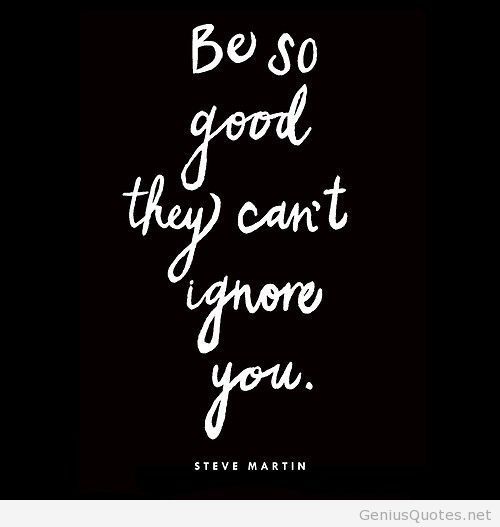
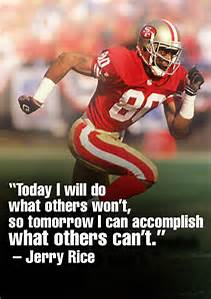
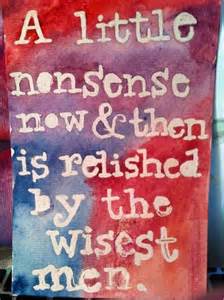
Quotations are also a very powerful tool. Depending on the source of the quotation people can attack a task in a different manner after reading the quote. A quote from Michael Jordan may prove more inspirational and freeing to a teenage footballer than a quote from Tony Blair. No matter how powerful. The converse is also true. Some quotes are so powerful that the source is not important.
Motivating Competition
Competition comes in different guises. Usually it is just something to overcome but it can serve to inspire as it did for Picasso and Matisse. As it does for Ronaldo and Messi.
- Why are they so good?
- What can I take from their game?
- How do they practice?
- What can I steal?
It is not just our direct opponents who are competition. Team mates are competition. In a way our heroes are also our competition, for one day, with a little fortune, we will replace them as players or coaches. We steal from our heroes and those we admire so that one day we will better them.
The best players are problem solvers. Armed with thought process that see pictures in a particular way. Good players will come up with a solution. Great players will come up with with three or four, then select the best one. With that best one sometimes being a solution that no one else perceived. They perceived it because their mind was open. Over their life they will have been exposed to a variety of situations in which they will have had to think. They will have got the answer wrong thousands of times, but each failure allowed them to seek a different solution. We can only find these solutions by asking questions.
If we can ask the creative questions, with complete freedom, in imaginative situations, with limitless possible outcomes, we might just find unimaginable answers.