One thousand touches.
For a time many coaches felt that the most important goal of a football training session was for a young player to get a minimum of 1000 touches of the ball. Rather like the 10,000 hour rule this seems to have fallen away but the core idea remains important.
When it comes to technical development the more opportunities a player has to touch the football the more likely they are to improve.
The most simple way to guarantee plentiful touches of the ball is to have a ratio of 1:1. One ball per player. Players will develop a relationship with the ball but the element of decision making will be virtually removed. There will be the decision of which surface of the foot to touch the ball with, which foot, how far in front to touch the ball and various other micro choices.
There therefore becomes a logical progression into 1v1. If players spend time learning to manipulate the ball and developing moves they need to put those into practice against an opponent. The level of decision making increases because of the presence of pressure. These decisions can be effected by game constraints. Is the objective to dribble through a gate? Is the objective to dribble through one of a pair of gates? Or into an end zone? Or is the objective to shoot into a goal? The constraints will effect how direct a player is, how often they twist and turn, their need to protect the ball, accelerate into space or just create enough room for a shot. That is just for the dribbler, the defender has their own ream of choices to make.
Except to pass. The decision of whether to dribble, pass or shoot is the simplified heart of the game. Movement off the ball and positioning feeds into tactical decision making.
So the logical progression takes us into 2v2 and usually onto 4v4 or 5v5.
Unless you are Horst Wein. Horst Wein advocated 3v3 or varying three player overloads, even a 3v0. Particularly for those below 10 years old. Wein was hugely influential in the development of young players not just in football but also in hockey. He worked with Inter, Barcelona, Schalke and many other clubs as he traveled the world sharing his ideas. Wein believed in following the laws of nature. He believed in letting kids be kids and stimulating children rather than instructing them.
Any child can tell you that with three players a triangle can easily be created. When it comes to passing the football a triangle is the optimum shape (though arguably a diamond is, depending on whether a coach sees a diamond as diamond or two triangles). The player on the ball has two options, making it harder for the defenders to deal with. The play can be stretched with width while at the same time producing depth/height. Varying combinations then come to the fore, overlaps, third man runs, up back and through are all possible in 3v3. In 2v2 the game is played in a flat line, whether that line is horizontal, vertical or diagonal it is still very easy for defenders to play against. Conversely for defenders it is very difficult to produce lines of defence beyond that of the “job and a half” (the player closest to the ball pressurises while the other drops off, covering the space in behind and also keeping an eye on the free player). With three players two lines can easily be created, with either dual prongs or a single point.
These advantages over 2v2 are also true of 4v4 and 5v5. My experiences have shown that even in 4v4 and 5v5 certain younger players do not get a significant number of touches of the ball. By playing 3v3 players will receive a larger number of touches than in 4v4 and 5v5 but fewer than 1v1 and 2v2. However, they will be able to achieve a greater number of technical and tactical decisions than within the 1v1 and 2v2 environments.
All of which I arrived at without any deep scientific study, merely through numerous years of coaching the game and the philosophy of Horst Wein at the back of my mind. Where possible my choice is to play 3v3 and use practices that are based on 3v2 or 3v1. My preference is to run multiple practices side by side rather than one single practice. This does involve trust and a sensible coaching position but by doing so hopefully the players get more touches and more opportunities to practice. I have also found it easier to plan for two 3v3 set ups and adjust upwards with numbers (one 3v3 and one 4v4 for example) than to plan for two 4v4 situations and adjust downwards. Sixteen should be a maximum for a training sessions with children, it is not the minimum.
Eventually a belief system needs evidence to support it. Most people have seen research that displays the benefits of small sided games over large sided games. There is some difference as to when a small sided game is actually a large sided game (8v8 would not be a small sided game for under 7s but might be for under 17s) but it is generally found that there are more touches and decisions per playing then when playing 11v11.
Very few studies compare small sided games to each other. Those few do show differences between 5v5, 4v4 and 3v3.
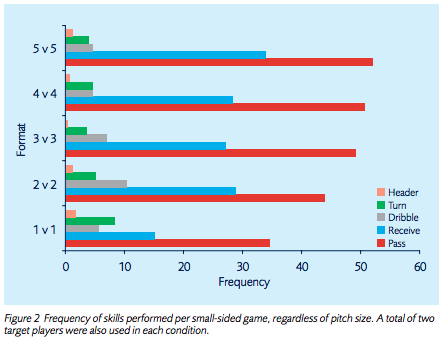
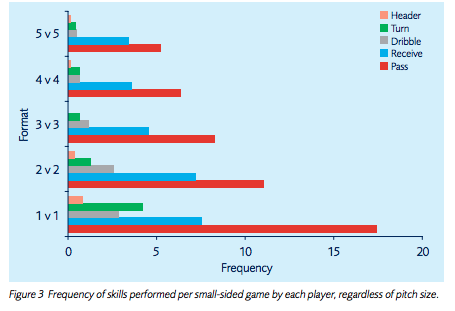
Research in the journal Insight (Volume 2, Issue 7, 2004) shows how the number of dribbles drops significantly from 3v3 to 4v4 and 5v5. While slightly more passes are performed the number of passes per player is considerably less, which should be expected with fewer players on the field.
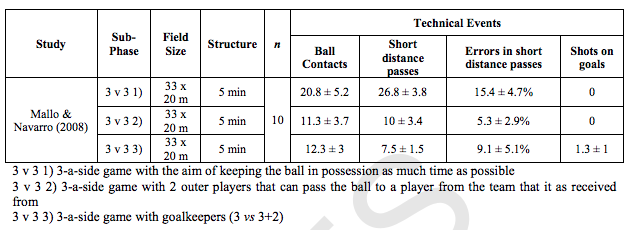
The research carried out in the paper “The Usefulness Of Small Sided Games On Soccer Training” indicates a greater number of short passes and shots in 3v3 than in comparison to 6v6.
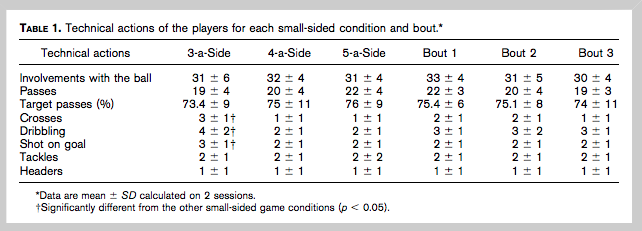
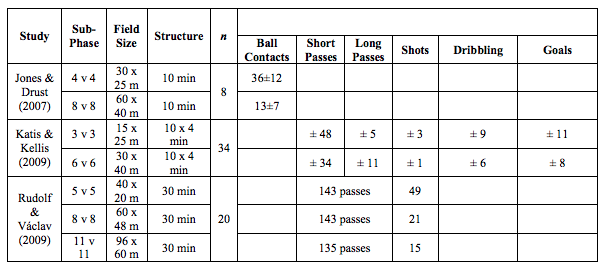
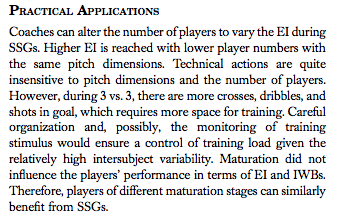
The above table indicates a greater number of shots, crosses and dribbles in 3v3 when compared to 4v4 and 5v5. The table comes from The Journal Of Strength And Conditioning Research (from Brazil).
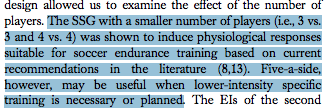
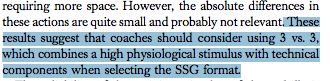
Without this becoming my very own research paper there are strong indications that 3v3 holds advantages over other formats, especially with younger players with lower attention spans.
This is not to say that 3v3 is to be played all session every session. To do so would be to ignore other elements of the game. It is vital that players can attack and defend 1v1, this should not be ignored. It is also evident that the game is not played with a small corner of the field. Indeed the aim of the game is often to get from that small and congested corner out into the wide open expanses which can then be exploited. That situation is unlikely to last very long before the game returns to a small area with one player on the ball and two close by that looks a lot like 3v3.
Football is an exceedingly fluid game and we need players who are capable of managing and taking advantage of all situations. Variety is the way to replicate these situations but we need to be aware that certain set ups will allow the balance between technical, tactical and psychological that different players at different stages of development need.
Evidence and experience suggests that 3v3 should play a key role in that development.
A series of videos interviewing Horst Wein can be found here.