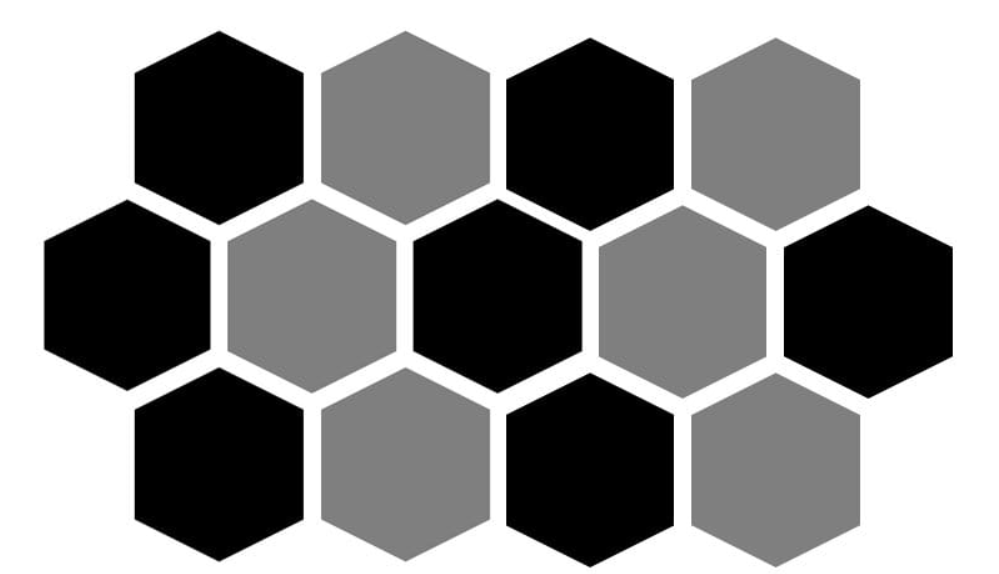
Bubbles are hexagonal.
More precisely, a raft of bubbles is hexagonal.
Nothing but physics guides the shape of the raft. There are no bees to craft a hexagonal hive. Merely economy of energy and strength in nature. Thus, the eyes of insects are hexagonal, water droplets are hexagonal, the skeleton of a sea urchin is hexagonal and so forth.
Despite the seeming dominance of chaos, nature seeks to self-organize. To create patterns.
Humanity shares this trait. We seek to organise the chaos around us. It is a trait that has pushed humanity forward but often created an urge for domination far beyond control. Yet, when humanity gets it right, the results are spectacular and possibly timeless.
Football is an example of humanity getting it right.
Not necessarily all that surrounds the game, or necessarily the scaled versions of the game used for young, developing footballers, but the 11v11 adult format. The formula is robust, resilient and easy to understand. Hence it’s longevity and popularity.
There have been adaptations to the laws but the core geometry of the game has remained.
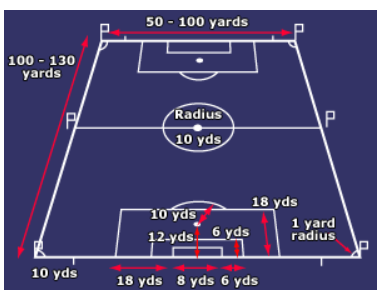
This geometry is undeniable and inevitable. It may be scaled for the younger players, or drastically adapted for practices or exercises, but this is the game (aside from an obscure form of three goal and three team football).
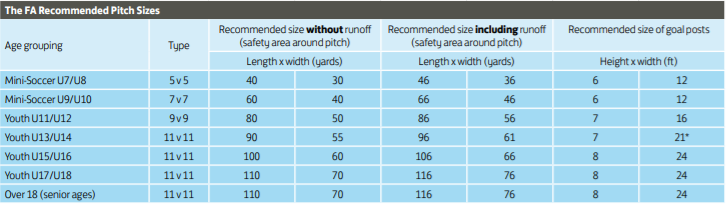
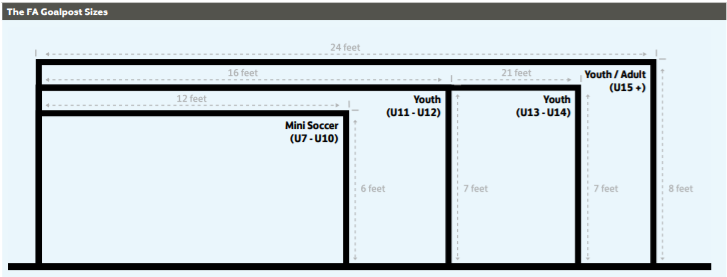

This is our container inside which all other geometry occurs. There are no limitations within this, aside from a few key laws.Such as the offside law, which adapts the length of the area depending on the defending team’s positioning.

Not only does this impact the distance between the part of the team closest to the goal but it also impacts the connecting distances between the units.
Goal kicks present their own changes to pitch geometry. The removal of the immediate impact of offside enables teams to utilise the full length of the pitch. The rules regards player positioning within the penalty area of the team taking the kick also change the geometric options available, affording players within the penalty area a certain amount of time and space. Goal kicks offer an opportunity to create structure both in and out of possession before the action starts. Whether a team is seeking to pass the ball short or play in a more direct manner.
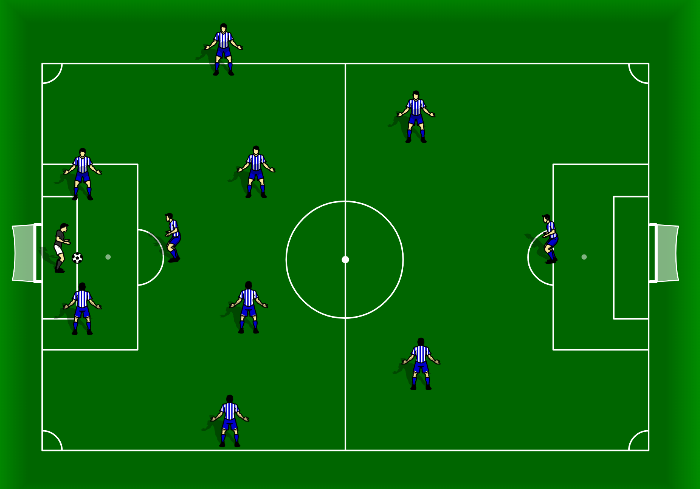
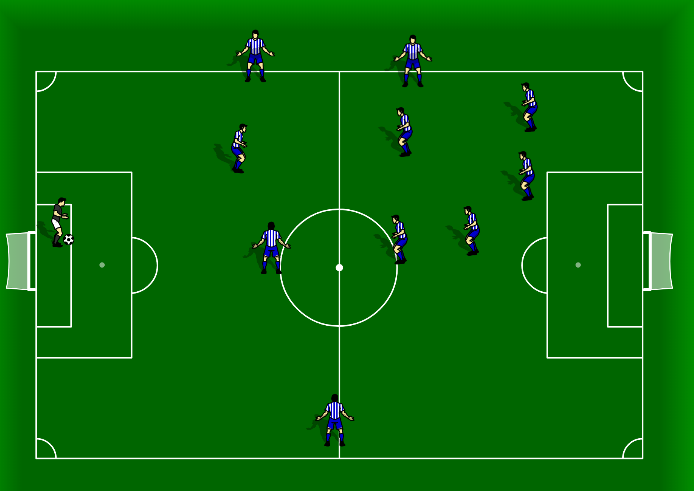

The goal kick provides teams an opportunity to create angles and distances to retain possession. Dispersing according to their own tactical preference. Out of possession the restart allows a team to form a defensive structure. The below might be used to counter press.
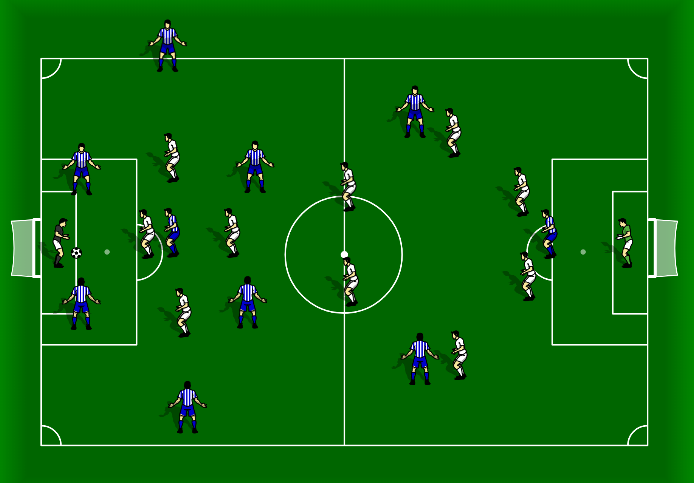
Both the offensive and defensive shapes are punctuated by smaller shapes. Triangles predominantly, but these interconnect into diamonds, squares, pentagons, hexagons and more. Here emerges football’s internal geometry.
The internal geometry is constantly changing. Coaches attempt to enforce their artificial shapes upon the fast-flowing interconnected ecosystem. In reality when two systems collide the results will never be identical. How the patterns adapt will decide who has control.
In these moments the system breaks into subsystems, each with their own geometry and seeking dominion over the other. Diamonds may face off against squares. Squares vs triangles as numerical superiority ebbs and flows.
Larger moments of the game have their own structures. All restarts represent a momentary calm wherein structures can exist in mirrored unison before the chaos strikes again. It should not be a surprise that many clubs seek to develop advantages strategies at restarts (it surprises many the number of clubs who do not).
Goal kicks are not the only area where rules have changed. The kick off has also changed. With the ball no longer required to travel forward two players are not required over the ball. This generates a wider array of options and structures.
A common error by the team out of possession on kick offs is to spread out. Defensively this goes against the principles of play. Gaps should be minimised, to deny space to the opposition, by spreading out the defending team are creating spaces for the opposition to attack.
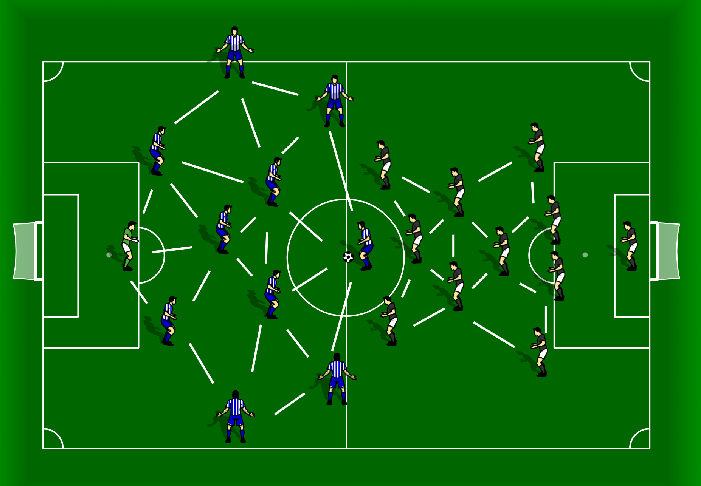
The dense honeycomb structures begin to form. These can be transferred into open play when both teams are settled into established territory.

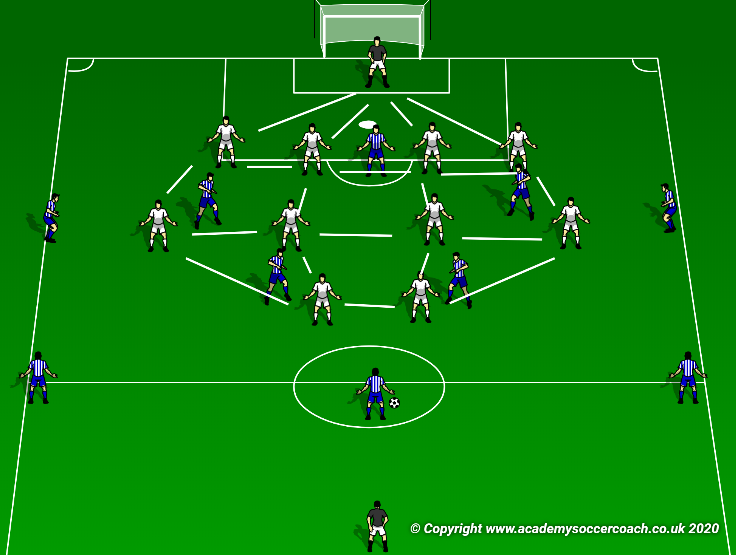
The geometry of the football pitch creates the ecology within. Those internal actors would, left to their own devices, self organise in some way. However, they are not left to their own devices, they organised to the will of their coaches. Nature would seem to have a better understanding of itself and its ecosystem(s) than footballers have of theirs. At least in the opinion of coaches.
Yet, the organisational skill of the coach is unlikely to extend as far as the sub phases of the game, where natural numerical self organisation begins to take over. The amount of players within a sub phase may be influenced by the overall shape, as if the distances are too great a limited number of players will be able to engage in the sub phase.
Nature’s shapes appear in a variety of situations. Not only in external structures such as eyes but also internally, within the carbon lattice of graphene and diamond.
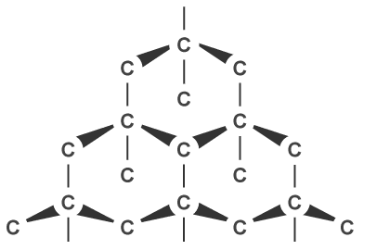
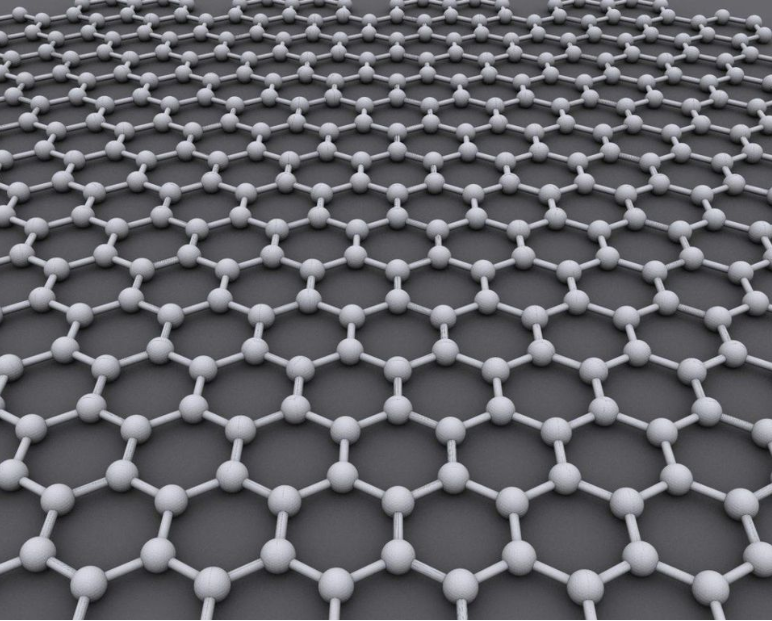
Graphene is not natural. It is the result of humans understanding and developing the atomic network of nature to create an even stronger structure. Graphene is a single, super thin sheet. K-4 is substance of far greater depth and thickness. Hexagons stacked upon hexagons, shortening the distances between the structures to create an impenetrable network.
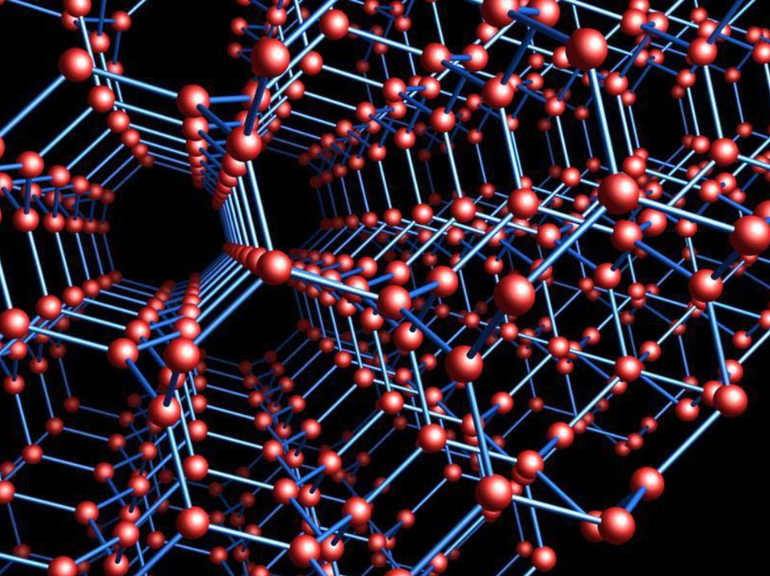
The formats of football create a geometry based on points that are temporarily fixed into position. Nature doesn’t haven’t to worry about whether it is in or out of possession.
As number structures increase the complexity and possibilities also increase. For these purposes we will only consider numerical equality in the set up.
Within 1v1 and 2v2 the points can only create limited options. The 2v2 dyad generates variables of distance and angle, but little else. The triad of 3v3 develops the extra dimension. The 3rd player brings forth the triangle. No matter where these players are positioned around the pitch a triangle should occur (unless they are precisely 3 in line). From here on in whether the format is 4v4, 5v5, 6v6 and so on, the shapes will be variances of triangles connecting with each other.
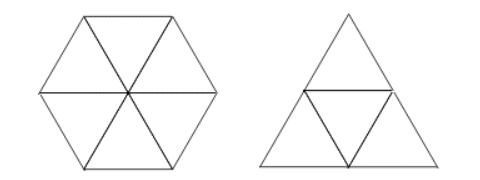
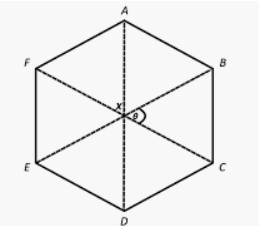
The cube has striking similarities with the Belgian 8v8 model. Two connecting diamonds, creating passing lanes while also generating structure, utilising the strongest small shape, the triangle and doubling into the diamond.
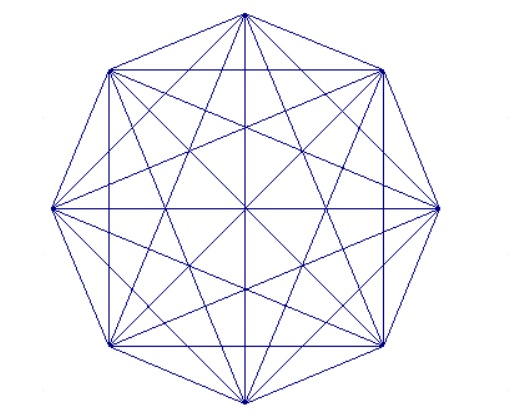
The cut diamond is structured around eight external points. Inserting three points anywhere inside (a triangle within) gives us eleven points. Each connection line is a possible passing line. A potential team structure, when in possession. Naturally occurring shapes occurring within nature and then replicating within sport. When maths is involved this appears to be inevitable. These shapes are chosen for their strength, for being impenetrable, or close to it. This suggests that they are most useful when out of possession. Nature has to deal with being open on all sides. A football team can not be attacked from all directions, so when out of possession only half of the shape is truly required in order to keep the distances between points reduced.
When a team has possession is when the gaps are created and the team in possession becomes vulnerable to counter attacks due to the spaces within its own structure. Spaces that the team has created for itself. A shape often not dictated by the game, not self organised and not natural. A shape created by the coach.

Coaches creating grids to help illustrate their ideal spacing. These grids form a further sub geometry to football, with coaches having their own formula based on their ideas. Zone 14 became a common focus.
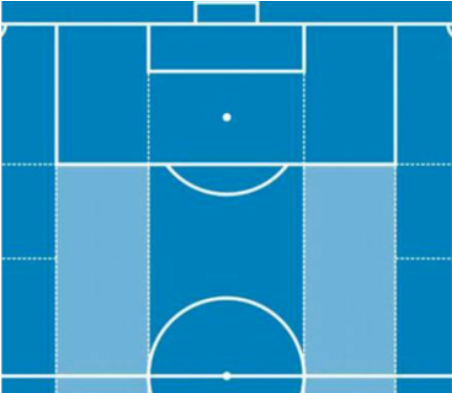
Zone 14 evolved and extended to the half spaces, a further area for teams to seek to dominate, identifying these positions as important in the creation of chances, to unlock opposing structures.
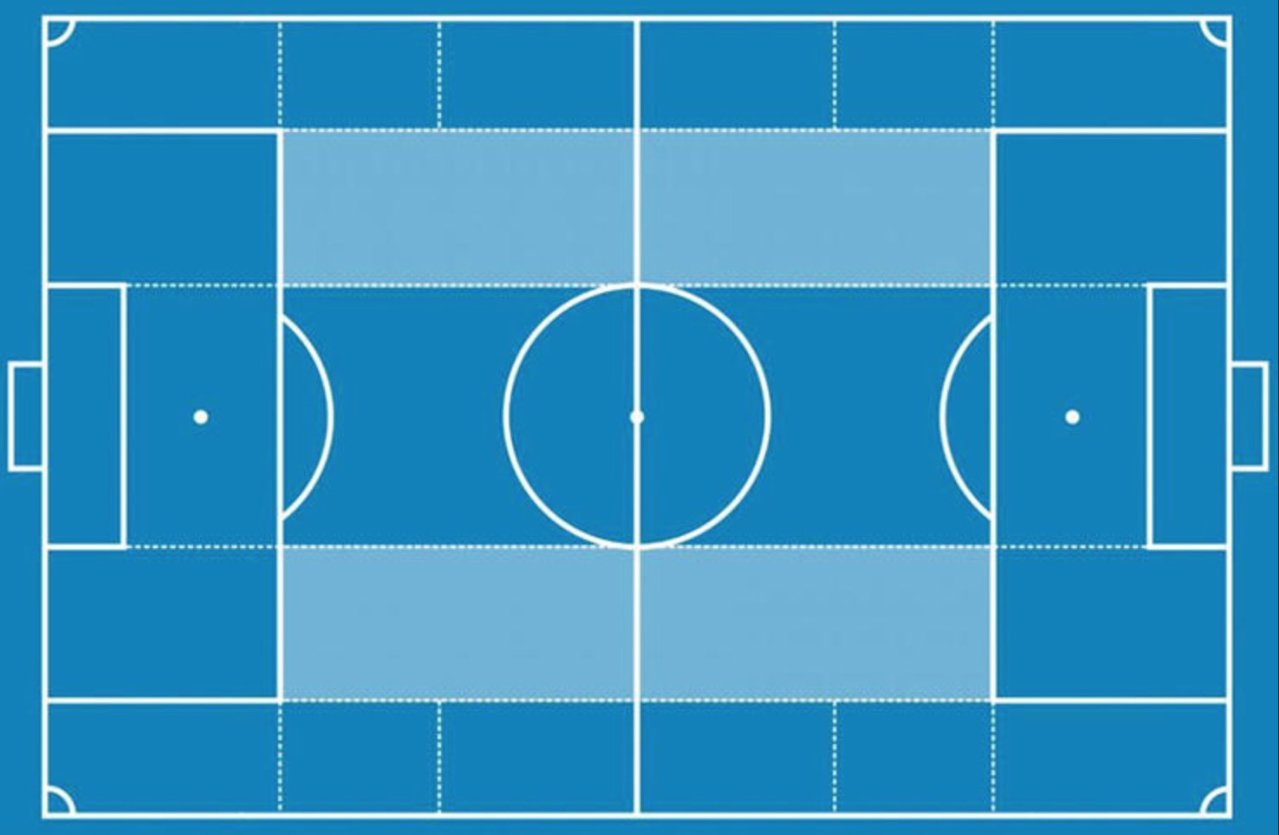
Pep Guardiola famously took this further and generated his own grid covering the whole pitch. This has been inserted into their training ground. Altering the geometric markings of the playing area to simulate their group geometry in game.
The priority for teams in possession has been to create and exploit space in order to score or maintain possession. This has been done by making the pitch big, occupying spaces in the furthest possible points (as with our mass our triangles).
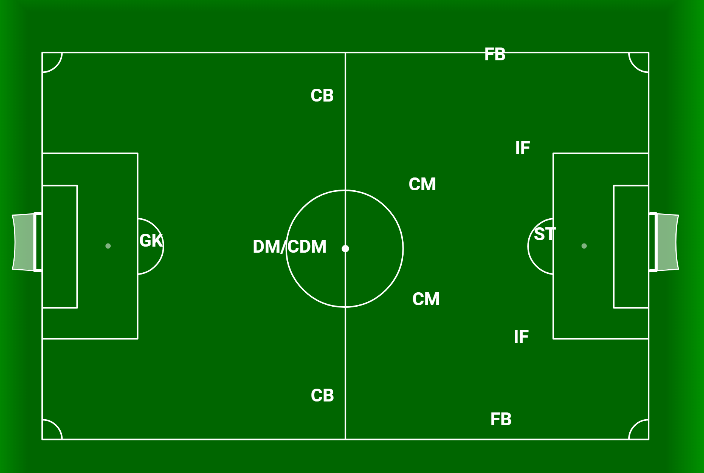
This 4-3-3 shape has become quite common with central defenders splitting and the midfielders protecting the open spaces.

Using two holding midfielders and squeezing the central defenders together closes the space and allows the full backs to get further forward. The attacking midfielder can also exploit zone 14.
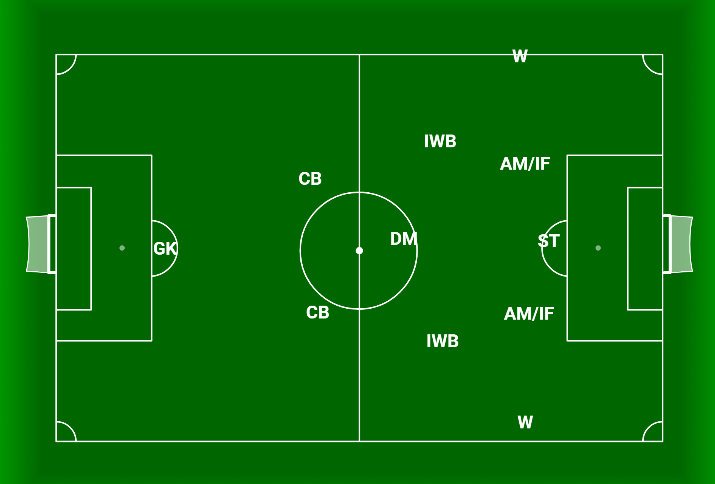
Using inverted wing backs can help close the gaps centrally and decrease their running distances when recovering (unless they have made a lengthy underlapping run). This shape also enables the inverted wing backs and inside forwards/attacking midfielders to operate in the half spaces.
The gaps in the team are quite large within all of the above structures. Julian Nagelsmann has sought to counter act the spaces and gaps by tucking the team in, playing within the width of penalty area, thus decreasing the gaps between players.
Can we use natures geometry to find a solution?
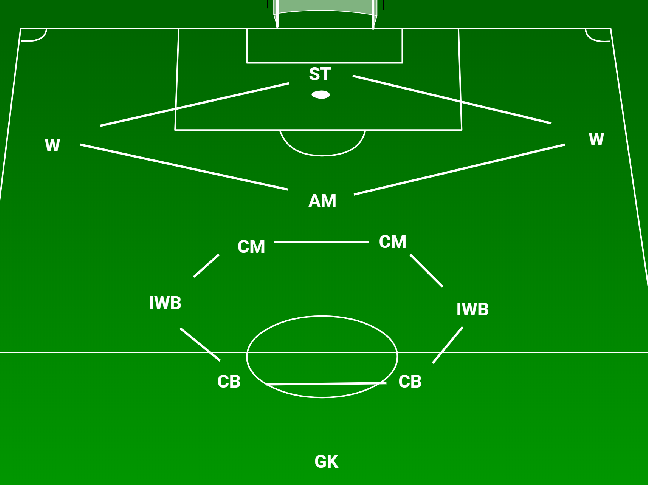
Six players form a hexagon close to the halfway line while four players create a large diamond in the attacking positions. The inverted wing backs (or full backs) can make underlapping runs while maintaining a defensive structure. Similarly, one of the central midfielders can make a forward run. The hexagon will be gone but at the minimum a square will remain.
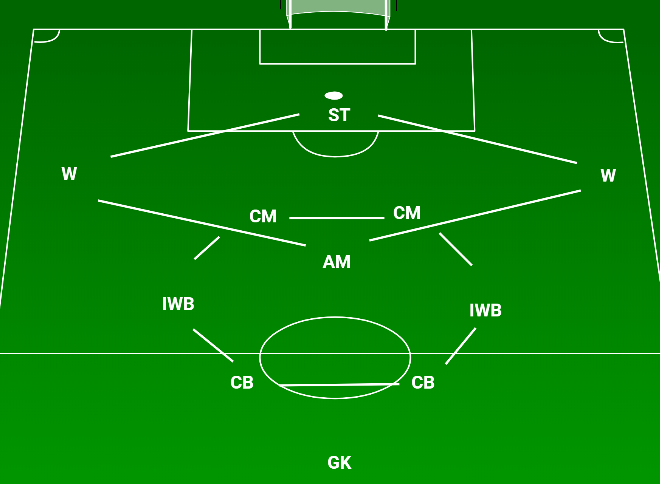
Should the attacking midfielder drop deeper the diamond and hexagon become integrated within what is a 4-3-3.
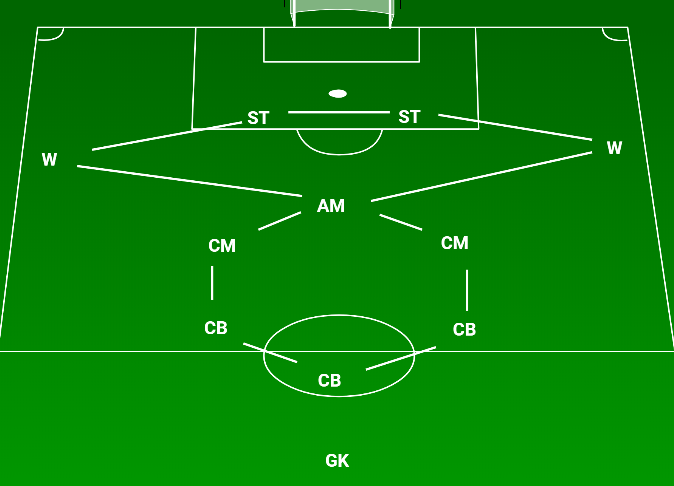
Should we choose to use 3-5-2 shape the hexagon and diamond become fully integrated. Our upper diamond is slightly flattened by the pair of strikers but the shape remains. The two central midfielders operate naturally within the half space. Should they narrow this would allow the attacking midfielder a huge amount of freedom, with little compromise in the anti counter attack structure.
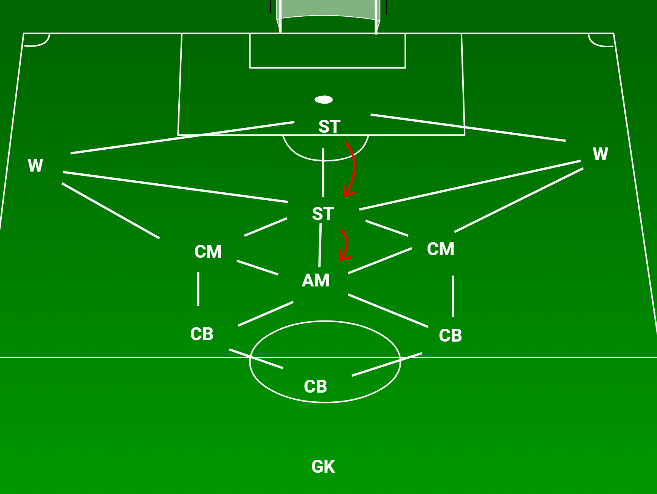
Finally, with movements from a striker and the attacking midfielder there is even greater integration of the two shapes. All of the shapes appear to like width close to halfway, but the wide players can easily drop to receive.
Using natural geometry may help us to solve the issue of dominating territory and possession, being impactful in attack, while not leaving ourselves open to counter attacks.