In Germany they are deeply proud of the Akademie.
It is in this school of football that the coaches we see working at the very top of German football gained their education. The reputation for developing tactically astute coaches, well versed in the intricacies of modern football is unparalleled, putting the Bundesliga at the cutting edge of tactical innovation.
Coaches are well versed in verticality, pressing, counter pressing, counter attacking, building from the back, utilising the half spaces and any other granular detail one would care to imagine. They apply it with great relish in training and on match day.
At times this leaves the impression that for such a tactically adept league it strikes just one note. Resonating throughout every side. A note that sounds much like Jurgen Klopp’s Dortmund in allegro.
Five years have passed since Klopp left Dortmund. Eight years since the last of Dortmund’s back to back Bundesliga titles and the dawning of a Bayern era that has taken in Heynckes (twice), Pep Guardiola and Carlo Ancelotti. Yet, it is not the Bayern style that is being replicated, but that of the Gegenpressing BVB.
Klopp remains the poster boy of German football coaching, perhaps even more so now he is leading Liverpool to trophies. His teams have been characterised by their use of a high defensive line, fast attacking football and quick regains of possession as close to the opposition goal as possible. Over time these elements have evolved, but the characteristics are generally the same.
With Borussia Dortmund a 4-2-3-1 formation was his general preference (without wishing to offend any goalkeepers we will assume that they are included in every line up without explicitly using an extra 1). Upon arrival at Liverpool he also adopted this formation, but alternated between this and a 4-3-3. Klopp became flexible with the line ups (at least on paper) and has utilised 4-2-3-1, 4-3-3, 4-Diamond-2 and, to a much lesser extent, 4-4-2 and 3-4-3, all in an effort to get the very best out of the available players. The term available players is important when considering the occasions when a 3-4-3 has been used from the start as this has been linked to injuries.
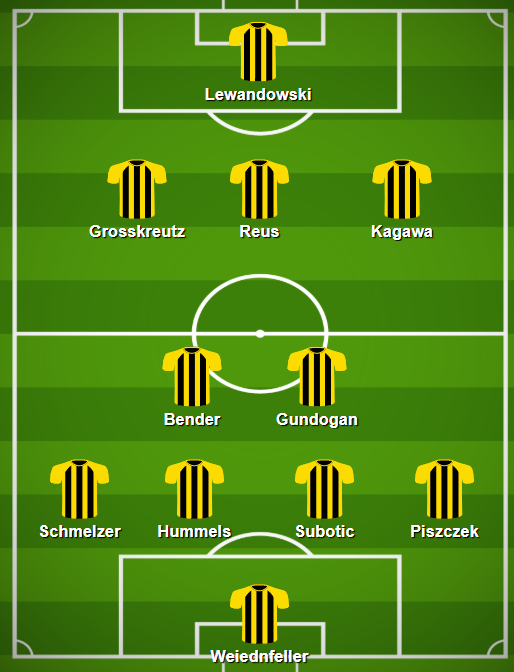
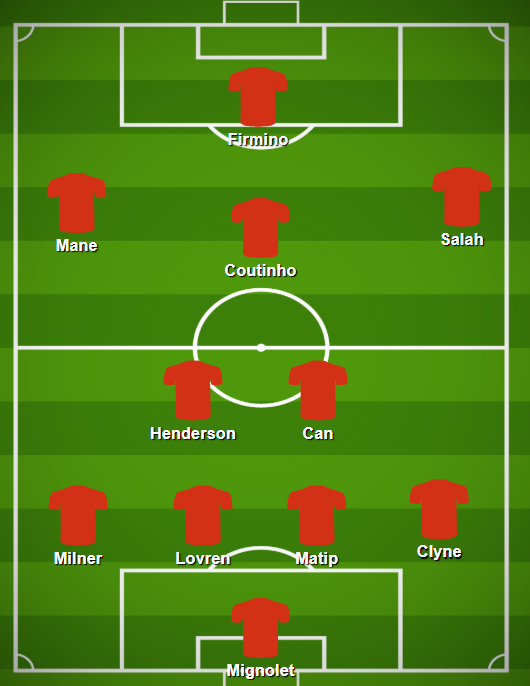
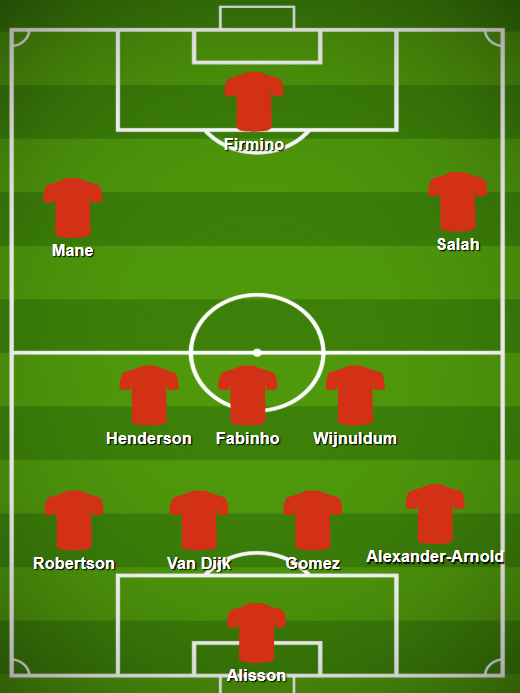
Klopp has also changed the manner in which Liverpool press. Initially they counter pressed veraciously and constantly, in the same style as his classic Dortmund. Henrik Mkhitaryan once described Klopp as sending the players out to chase the ball like school children. While the Liverpool of 2020 still press, the tendency is to be more selective about the moments in which they press while also using the front three of Salah, Mane and Firmino to cover passing lines before pouncing. Pepjin Ljinders has discussed how they work on the front three playing against five or six in training to practice these situations.
One of keys to Klopp’s success has been his evolution.
In the Bundesliga things have evolved too. The trend for counter pressing has helped usher in a new era of three man defensive lines across the division. For decades German football deployed three at the back systems, lasting through the 1960s into the late 1990s with barely a back four in sight. The 3-5-2 of the time allowed for use of a sweeper, wing backs and two strikers. German football thinking suggested that the 3-5-2 covered the spaces of the pitch and also enabled cover between the defensive lines. With the early 2000s reboot came four at the back, but now a member of the back four has been removed in order to provide an extra pressing player.
The high levels of verticality, always seeking penetrative passes, in combination with counter pressing has created a spectacle of constantly shifting lines, being broken, then rearranged only to be broken once again. The tempo of a match between two Bundesliga teams of relatively similar standing can be utterly ferocious, making the allegedly unsophisticated football of 1970s England looking cool and calm.
Leading the way in this spectacle are RB Leipzig and Borussia Dortmund, in their current post Klopp guise.
Klopp’s work at Anfield is far from finished but there are those who have already earmarked Julian Nagelsmann as his natural successor. The German methodology has become embedded into the Anfield culture. Nagelsmann is only 32 years old but has been coaching in the Bundesliga since 2016. He is already close to replacing Klopp as the German coaching poster boy. If he is not yet the featured star on the poster, Nalgelsmann is certainly the Wunderkind. Currently coaching at RB Leipzig, the relationship between Fenway Sports Group and Red Bull has been mostly cordial, as though the organisations recognise kindred spirits with matching, analytical approaches to recruitment. The casting appears natural.
Tactically Nagelsmann’s RBL switch with regularity between formations, with different shapes being the favoured default at varying stages of the season. At present it is variant of 4-4-2, with the wide midfielders so narrow that it could at times be described as 4-2-2-2. At other stages 3-4-3 and 3-5-2 have been preferred.
Similar to Klopp, no matter the formation in use key playing principles are in evidence. As well as the now familiar German template a core feature of the Nagelsmann way is narrowness in possession. When in their own half RBL (perhaps more specifically their own defensive third) make the pitch as wide as possible but once the ball has progressed into the central third the default shape of the team is much more narrow than would commonly be expected, the full backs or wing backs do not reside on the touch line, but are virtually in line with the outside markings of the penalty box. Width tends to emerge through movements from in to out, either from a striker or midfield player, meaning that until the final third the majority of full back/wing back runs will be underlaps rather than overlaps. Should the ball be wide on one side of the pitch the opposite side wing back/full back will generally be tucked into an inverted position.
By having a narrow team shape Nagelsmann compacts the spaces between his own attackers. The dual impact of this is that the players seek numerous rapid one and two touch passes but also allows for extremely quick counter pressing as players will be close enough to each other and the ball to swarm in twos and threes. The compact nature lends itself to the now trademark Leipzig style that began with Ralph Ragnick and has intensified with each passing manager.
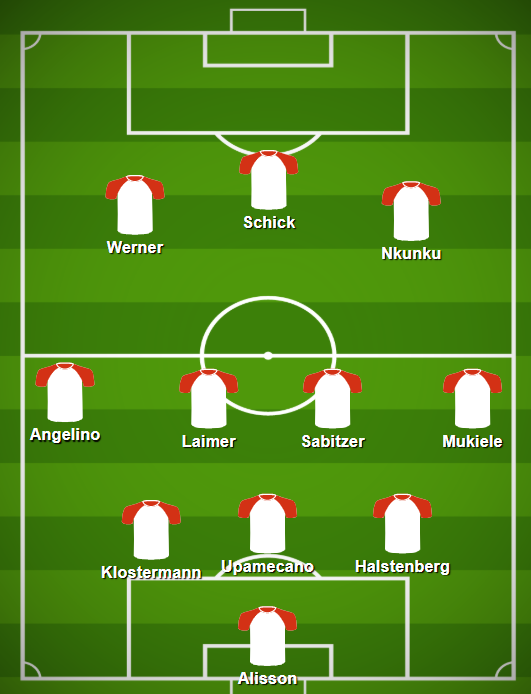
The principles of compaction create even greater fluidity within the side, which allows for the regular shift in team shapes. Rotation is another playing principle that should be associated with Nagelsmann. Players have license to hunt the ball and license to attack with forward runs in combination, exploiting spaces. Thus team mates must occupy the spaces. For Leipzig it matters that the spaces are occupied, it does not matter who is occupying them.
With such dynamism come multiple goal threats. While Timo Werner is undoubtedly the biggest goal threat for Leipzig players from all over the pitch have weighed in with contributions. Over 100 goals have been scored in 2019/20 with four players into double figures.
Werner is the main threat from breakaways, but when teams are well set defensively Leipzig often use crosses to crack open the opposition. The wing backs and full backs delivering from their relatively narrow position, looking to pick out Poulsen and Schick much as Liverpool use Robertson and Trent Alexander-Arnold to deliver, albeit with the delivery from marginally differing areas.
At Dortmund their use of wing backs has unleashed the team as an attacking force. Lucien Favre inherited a highly talented young squad in 2018. Initially using a back four Dortmund played with exciting verve. Until they stagnated. It was at this stage that Dortmund shifted to a back three to release Achraf Hakimi and Raphael Guerreiro.
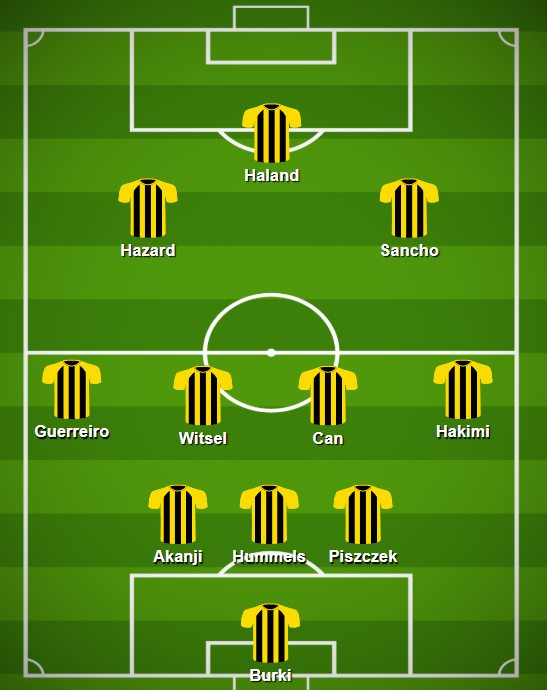
The Dortmund front three of Reus, Sancho and Hazard (with Brandt rotating in) operated with freedom. Marco Reus deployed as false nine, allowing the other two forwards to float around, mainly sticking to their side of their side of the pitch, but not limited to this. Which was until another piece was added to the Dortmund puzzle. The far more fixed presence of Erling Haland.
In the second half of the 2019/20 season Dortmund could be seen as a team that defend with five (plus the goalkeeper) and attack with five. This may fluctuate between attacking with six and defending with four depending on the inclusion and decision making of Emre Can. Axel Witsel has the holding role, rarely straying too far from the three central defenders. Emre Can provides a box to box presence.
The wing backs and inside forwards are granted freedom to attack. Hakimi and Guerreiro get into forward position in slightly different ways, but their duty is to attack.
The left and right sides of Dortmund are not direct mirrors of each other. On the left Guerreiro has a tendency to invert. This should not be surprising given his history playing as a central midfielder. This is not to say that he exclusively takes up central positions, but this does mean that the relationship between Guerreiro and the left sided forward is such that they take their positions from each other. If Guerreiro is wide, the left forward is infield and vise versa.
Hakimi’s movement is more generally to overlap, though he will also make underlapping runs into the halfspace depending on the position taken up by the right sided forward. Both wing backs generally deliver the ball low into the penalty area, with one assisting the other on occasion this season, a further indication of how far forward the wing backs are encouraged to go.
When Dortmund played with a false nine the freedom of the front free made them extremely difficult to mark, but they also lacked a central presence. When Dortmund stagnated much of this was because their penetrative play had disappeared with no one to play into. Possession was kept in front of the opposition defence without disrupting their organisation.
The combination of Haland lending that focal point and the additional use of wing backs allows the remaining two attackers freedom of movement. Labelling them as specific roles is a vexed problem, They have been liberated from such labels. The specifics of the individual impact their approaches. Differences between Hazard and Sancho are stark, with Hazard performing a more languid playmaking role, while Sancho’s play is electric and always seeking end product.
Dortmund’s counter pressing is far less rabid than Leipzig. The distances between players being much greater, making the initial press far more difficult. Their pressing can be seen to be reliant upon triggers, with the first trigger being the loss of the ball (as it is for all counter pressers). Which personnel are on the field can have a major impact on the effectiveness of the Dortmund press. The larger distances can be made up for with sheer physicality and speed, with faster fresher players the BVB press has greater effect.
Another difference between Nagelsmann’s press and Favre’s is that Dortmund are not necessarily looking to win the ball high, they are looking for the errant pass that allows a central midfielder or defender to intercept and launch an attack. The press from the forwards is in relation to the cover of midfielders and defenders, keenly seeking opportunities to recover any imperfect pass to counterattack. With three central defenders players like Akanji can be on the front foot, looking to step in front of opponents to win the ball, safe in the knowledge that there is ample cover behind.
How does the playing style of these two Bundesliga clubs have any impact on Liverpool?
There are clear similarities between core features of the Leipzig, Dortmund and Liverpool game models. The Liverpool senior coaching team often talk of intensity in everything they do. The team will play forward with regularity as they are not fearful of losing possession, as the loss of possession is an opportunity to press. The ferocity of Liverpool’s pressing has toned down somewhat, but pressing is still key to Liverpool. The Liverpool front three play with freedom and fluidity, with the fullbacks the key to Liverpool’s attacking play, particularly against deep defensive blocks. Liverpool do this from a system deploying a back four.
Due to the global pandemic Liverpool are being extremely careful with their finances. They withdrew from the race to sign Timo Werner, suggesting that funds are not available. Werner’s release clause made him attractive but if Liverpool are unable to find the fee for Werner they will certainly not be able to find the fees for players who do not have such attractive clauses.
How then can the squad be freshened? A team that has dominated the Premier League in the 2019/20 season may not appear in desperate need of refresh but there have been no significant additions since the summer 2018 transfer window. Stagnation is the enemy of continued success.
One possible method is to freshen the team tactically, deploying a system that retains the keys to the Liverpool game model but enables players to perform in a different manner. The cliché of returning players being “like a new signing” is hackneyed and rarely resembles reality. Players moving into different roles and being revitalised is far more common.
The rotating, counter pressing chaos of RB Leipzig may not be a good fit for the current Liverpool. A version of the more composed, fluid but with a firm base, 3-4-3 of Dortmund could offer the next step in Klopp’s evolution.
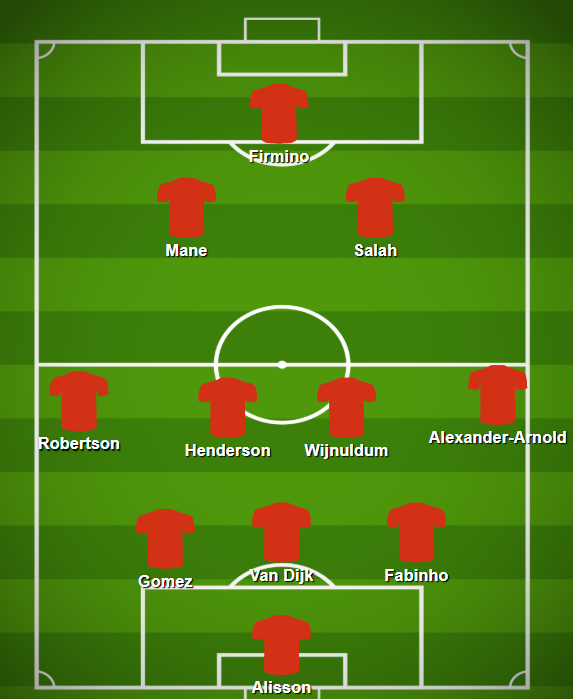
In version one of a potential Liverpool 3-4-3 the dramatic changes are the use of Fabinho as a right sided central defender rather than Matip or Lovren. Fabinho might also be used as the central of the three defenders, easily stepping up into central midfield. However, his experience as a full back prior to arriving at Anfield will offer greater cover on the right hand side. Gomez also has experience playing as a left back and can cover Robertson’s spaces. Using Van Dijk as the central player will enable his superb passing range to shine.
The key change is to push Alexander-Arnold further forward. It is acknowledged that his strengths are going forward and many opponents target him at right back. By pushing him Alexander-Arnold further forward in the manner that Dortmund use Hakimi the attacking attributes can be utilised yet further. Particularly with the additional cover behind him in Fabinho. This may also allow Alexander-Arnold to take up goalscoring positions within the opposition penalty area.
The front line is unchanged, the bigger change would be the role of Jordan Henderson. Henderson would return to the holding role he only recently shook off.
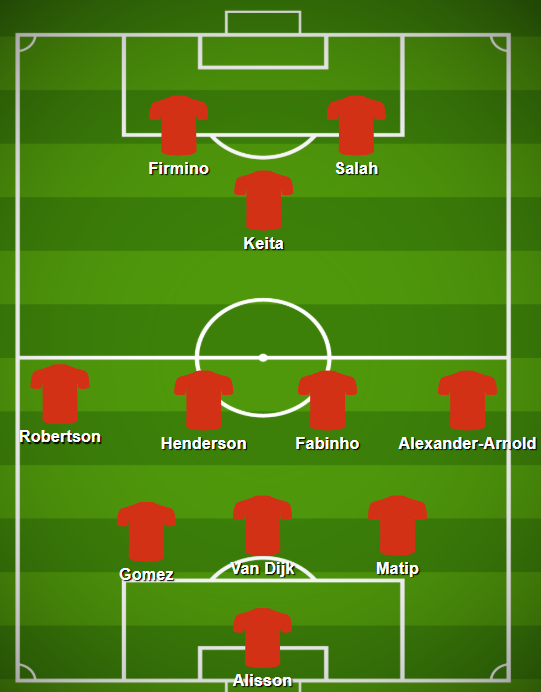
In the second option Fabinho retains his position as a holding midfielder. The only change is to take Mane out of the lineup, pushing Salah narrow to play as a striker alongside Firmino. Firmino would naturally drop deeper, creating the possibility of a rotating triangle between the three highest players. Into the line up comes Naby Keita. Keita is still yet to reach his expectations. Statistically he appears to be delivering, but the 2019/20 season has been disrupted by injuries. Freeing Keita into a eight and a half position might bring out his optimum performance levels.
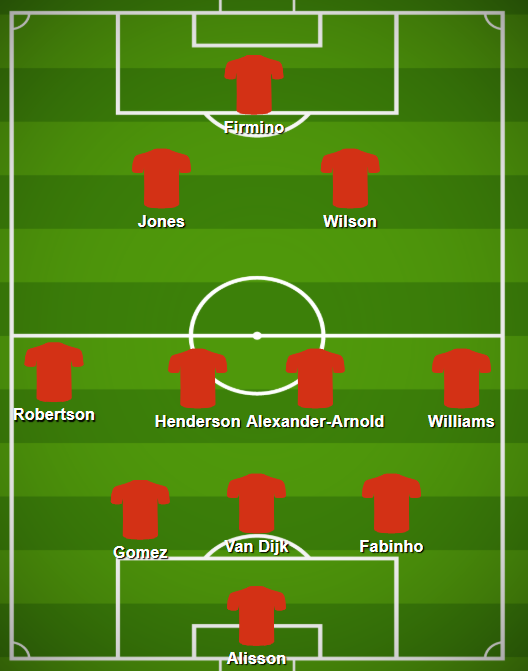
Option three is designed to show how greater use of young players and reintegration of a player out on loan could fit into the versatile 3-4-3 shape. In the front line Curtis Jones and Harry Wilson playing as attacking midfielders with freedom of movement, in the style of Hazard and Brandt. On the right Neco Williams has the energy and quality of delivery to play as a wing-back.
Trent-Alexander Arnold moves into central midfield. Observers suggest that this could be his best position in the future. He certainly possesses the passing range to perform as a pivot in a central zone. In addition to performing “quarter back” duties Alexander-Arnold would be able to pick up positions in the right half space from which he could deliver devastating crosses in the manner of Kevin de Bruyne as Manchester City.
As well as enabling players an opportunity to exhibit further aspects of their game the adoption of a 3-4-3/3-5-2 system as the preferred default would make Liverpool harder for opponents to prepare for. Using virtually the same personnel as Liverpool’s successful 4-3-3 would also allow for seamless in game rotation between systems. Jurgen Klopp has stated that he aims for his players to find solutions to problems in games, being able to make autonomous tactical changes is the ultimate step in player problem solving.