Hands.
On the football pitch only one player has this advantage. The ability to block, dive, stretch, punch, catch and throw.
No player has a spotlight shone on them like the goalkeeper. No player’s moments of brilliance can be wiped out by am error in the way that a goalkeeper’s can. That string of brilliant saves count for nothing when an error changes the game.
It takes a special individual to be a goalkeeper. A commanding presence. A dominant persona. A great communicator. A consistent, error free footballer.
These are the cliches of goalkeeping. The knowledge of this undoubtedly specialised position, for the majority, is limited to these cliches. People know that the goalkeeper is important, but most of them don’t really know precisely why.
Every single footballer is a unique individual. Just like every single person on this planet. Every single goalkeeper is unique. They have their own personality. This instantly starts to break the cliches. David Seaman took great pride in his error free and consistent style. This style brought him multiple trophies and international caps. Bruce Grobbelaar was a maverick, throwing in surprising and shocking mistakes. In terms of trophies he was more successful than Seaman. Bruce Grobelaar’s adventurous style suited the Liverpool team of the 80s. David Seaman’s conservatism suited Arsenal of the 90s and 2000s.
In the 1970s the Netherlands had an outstanding shot stopper. His name was Jan van Beveren.
In the Total Football philosophy this was not enough. The Netherlands chose Jan Jongbloed. Jongbloed was considered much faster coming off his line and better kicking the ball. The trade off was some shot stopping ability for a player who could sprint outside his penalty box and get to the ball before an opposition striker, even if he just kicked the ball into touch.
The evolution of the position had begun.
Conservatism reigned supreme, particularly the ability to catch crosses. At least to the British. In European competition foreign goalkeepers who chose to punch crosses were viewed with a great deal of suspicion. They are goalkeepers, the minimum they can do is catch.
Then in 1990 audiences were introduced to one of the football’s great mavericks. A player who took the sweeper idea of Jan Jongbloed and embellished it further. There was nothing conservative or error free about his play, but there was flair, freedom and excitement.
Rene Higuita’s style was very unlike the goalkeeper’s of Europe. While Bruce Grobelaar (not European) shared some of Higuita’s traits he seemed tame in comparison. The introduction of the back pass rule in 1992 meant that goalkeepers from all nations were now challenged to use their feet.
South American goalkeeper’s have always been different. They have another great tradition that we European’s seem to have missed out on. The goalscoring goalkeeper. It should be no surprise that Higuita had over 40 goals to his name, yet he is a long way behind Jose Luis Chilavert with 67, including a hat trick of penalties.
Then there is the goalkeeper with over 100 career goals, Rogerio Ceni. Ceni scored over 60 free kicks in his career. The logic of defenders and goalkeepers taking penalties should have been obvious. They have to kick the ball the furthest most often. Of course they will have powerful shots. No goalkeeper will save a ball they have blasted.
In the 2000s English audiences had a glimpse of Schalke. In their goal was a young Manuel Neuer. Neuer made a series of superlative saves but notably he positioned himself far from his goal when the ball was in the opposition half. Not only did he rush from his area to clear the ball but Neuer would take control of the ball and start the next attack with a crisp pass from his feet. When Schalke had possession Neuer would position himself away from his goal to receive passes. He was an extra passing option. Schalke truly had 11 passing options.
Meanwhile over in Spain Josep Guardiola was using Victor Valdes in a similar manner. The goalkeeper was the first attacker. Valdes was not the only Spanish goalkeeper to be more than competent with the ball at their feet. Pepe Reina came through the Barcelona academy with Valdes, he too had an excellent touch and range of passing.
It is now the accepted expectation that goalkeepers are high quality with their feet. If a goalkeeper is unable to control the ball and play simple passes they are unlikely to last very long at the top end of football. Witness Guardiola’s sale of Joe Hart because his ability passing was not up to Guardiola standard. Also witness the purchase and discarding of Claudio Bravo because he was not good enough with his hands. Passing and control may be key but the number one job of the goalkeeper remains the ability to make hand saves. In the 2017/18 season Guardiola seems to have found the perfect balance in Ederson. Ederson posses an extraordinary range of pass and composure on the ball. His sweeper keeper traits were graphically illustrated early in the season when rushing from his goal and being injured by Sadio Mane as both players sought the ball. Later in the season Ederson’s passing bypassed Spurs pressing game, adding further variety to Manchester City’s game.
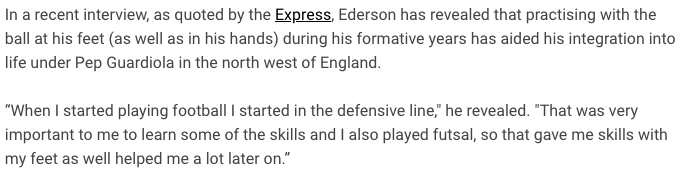
There emerged a number of stories where Ederson credits his ability with the ball at his feet to futsal, football’s cousin.
The rules and traditions of futsal are restrictive to the goalkeeper. There are no goal kicks, play restarts instead with the ball in the goalkeeper’s hands. The goalkeeper may receive a pass from team mates once within the one move (if a player passed the ball to the goalkeeper, who then passed to another team mate, the goalkeeper would not be able to receive the ball again unless it has been touched by the opposition or gone out of play). The goalkeeper also only has four seconds in possession before the opposition receive a free kick. That is unless the goalkeeper is in the opposition half.
The goalkeeper in the opposition half. This tells us a lot about the role of the goalkeeper in futsal. It is very common to use the goalkeeper as an extra outfield player in order to play five vs four outfield. This can be done to control possession or create a greater goalscoring opportunity, the risk of course being that the goal is unguarded.
At the moment the two most high profile futsal goalkeepers are Paco Sedano, the great Spanish veteran. Possessor of a grand trophy cabinet that includes Futsal World Cups and European Championships. The other is Higuita (not the Colombian maverick). A 31 year old, Brazilian born, Kazakhstan goalkeeper.
Paco Sedano is a conservative goalkeeper. Good with his feet but excelling at close range reaction saves. Much in common with the handball goalkeeper in that regard. Higuita is much more of the outfield player. His abilities with the ball at his feet have forged the strategy of Kazakhstan for a number of years. They can attack with five whenever they choose. This strategy is viewed in different ways. Some see it is a slowing of the game. A movement away from a pure futsal. Others consider it a a key component of futsal, one that is a major part of the identity of the sport. The fly goalkeeper.
There may be restrictions within the rules of futsal but the size of the court allows for great freedom. In football the most obvious difficulty in granting complete freedom to the goalkeeper is the size of the pitch and being unable to cover the very large goal that has been left unattended.
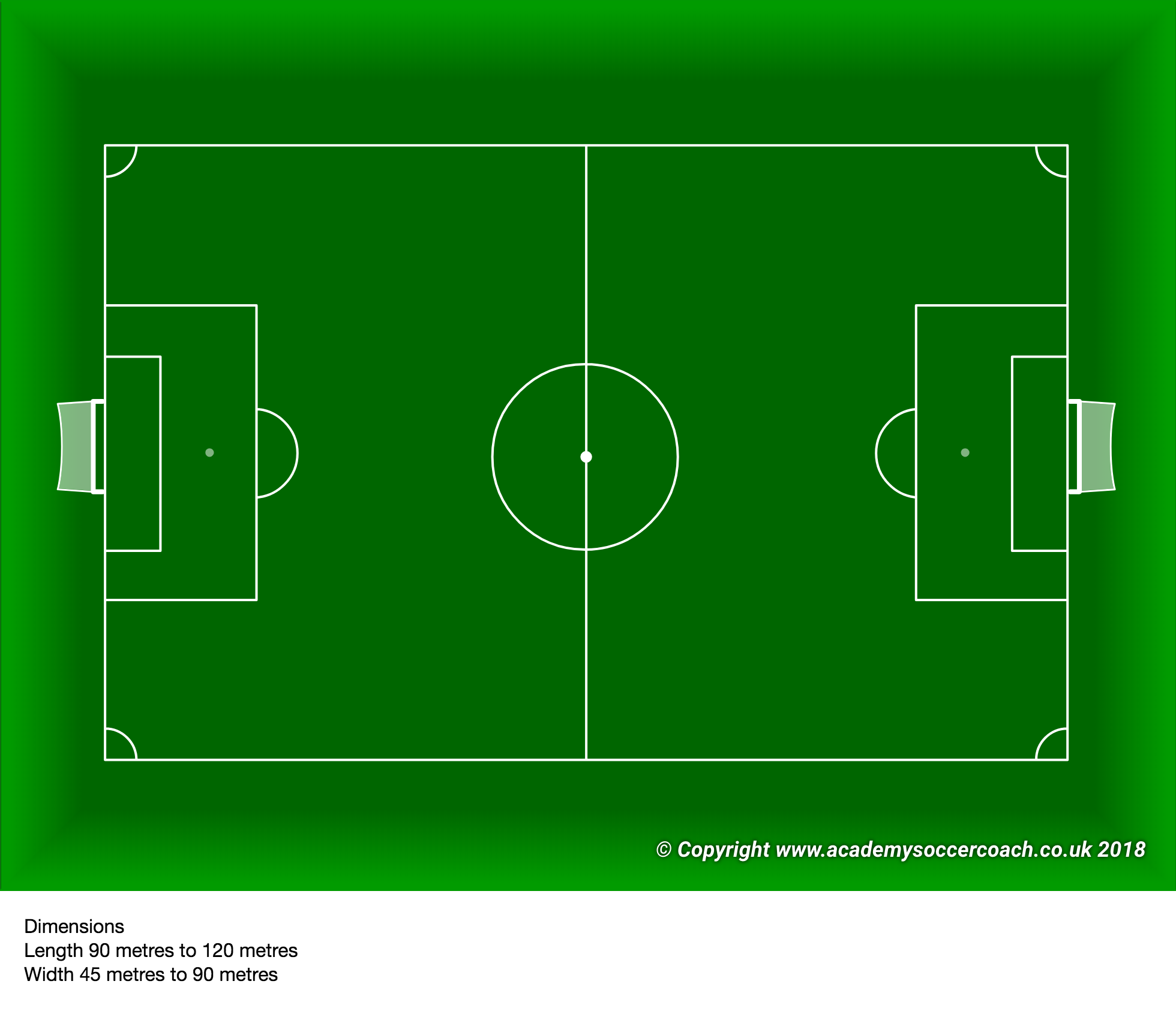
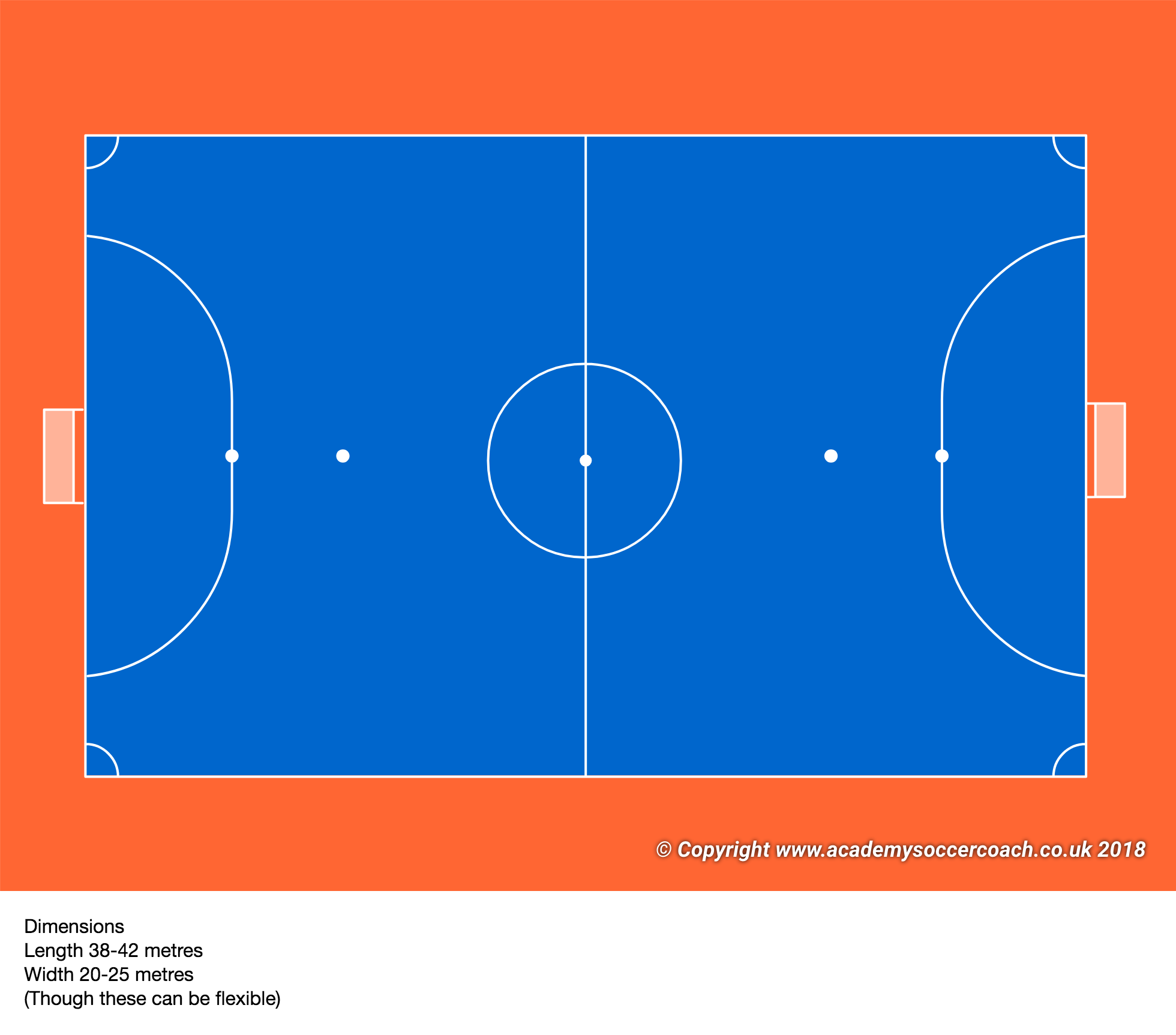
The futsal court dimensions allow the goalkeeper to join attacks and still have a chance to cover the goal. Yet, not all goalkeepers in futsal are of the same ability with the ball at their feet as Higuita.
That is not really an issue. The rules of futsal allow for rolling substitutes. Substitutes in futsal may be made as any time, without alerting the referee. The players must pass through two specific lines in front of or next to the team bench. If they do not cross through the lines then it is considered a foul. So now there is another dimension to the game. At any time an outfield player may take the field in place of the goalkeeper. This outfield player must be pre selected before the game and wear a goalkeeper shirt. Teams will look to establish possession either in the opposition half or close to it then exchange their regular goalkeeper for their fly goalkeeper. When they lose possession the fly goalkeeper and goalkeeper will look to switch as quickly as possible, reestablishing the status quo whilst defending.
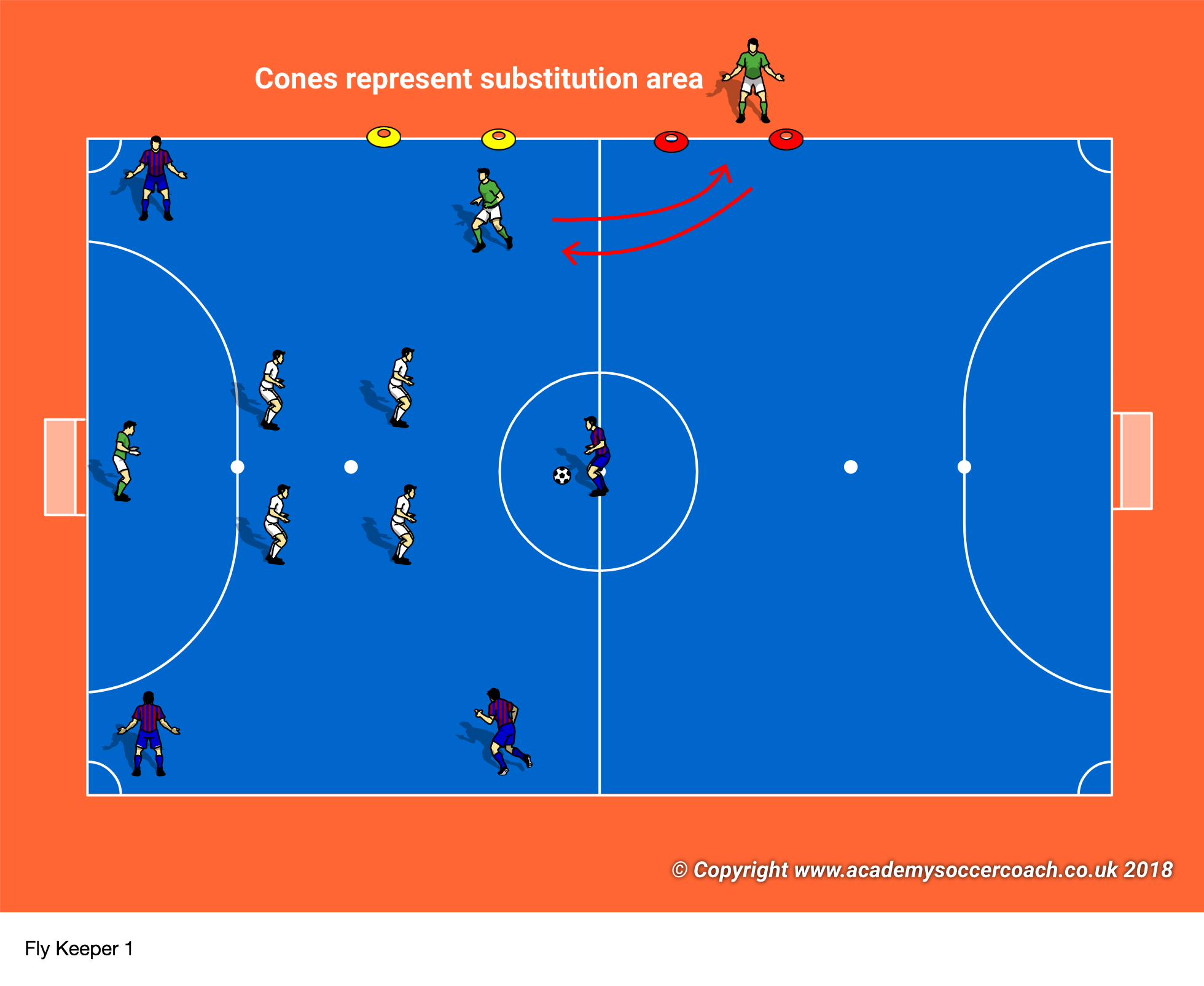
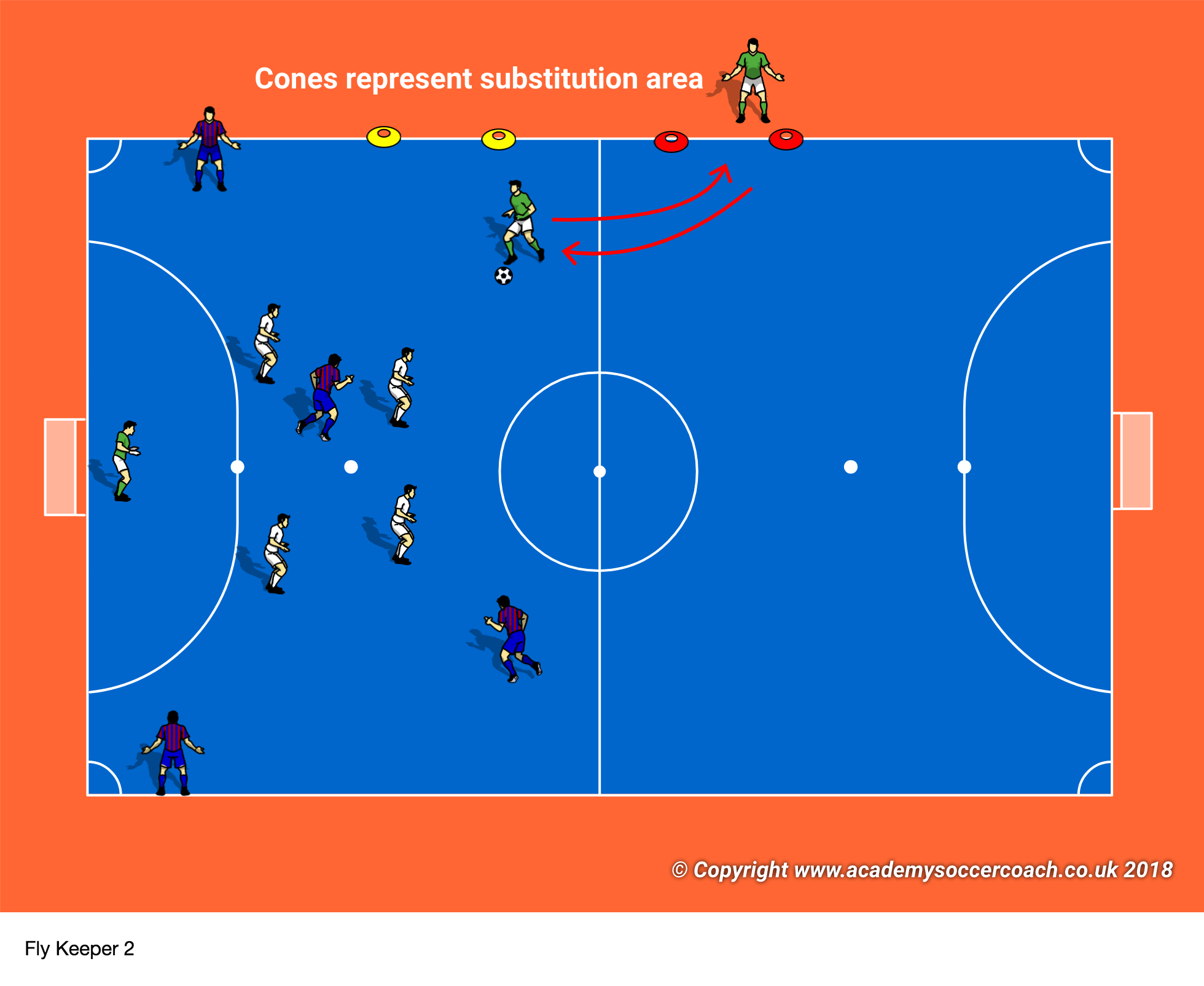
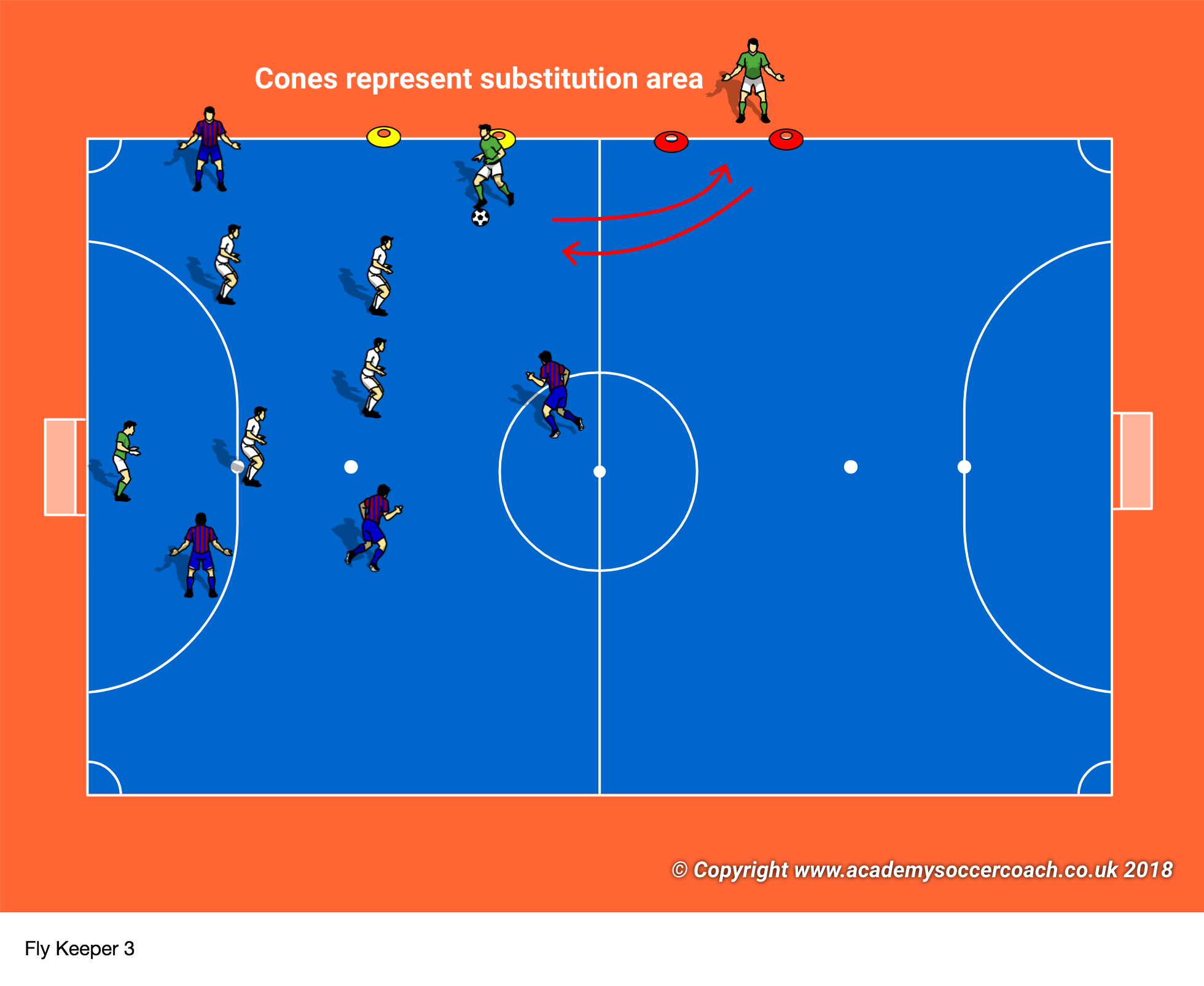
The better a team is at using the system the less likely they are to position the fly goalkeeper close to the side line. If the fly goalkeeper has a powerful left foot strike then standing him high to the right hand side is a good option, but the choice of fly keeper might be for different reasons. The player may be excellent at cutting balls across the goal, in which case they may be positioned in a corner. The variations are plentiful but the common factor in success is fast ball movement and players rotating position.
The football sweeper keeper may never develop to the degree of the fly keeper in futsal. As well as the dimensions of the pitch we do not have the capacity to make rolling substitutions without first addressing the referee and waiting for play to stop. We do have more than just the 11v11 game format.
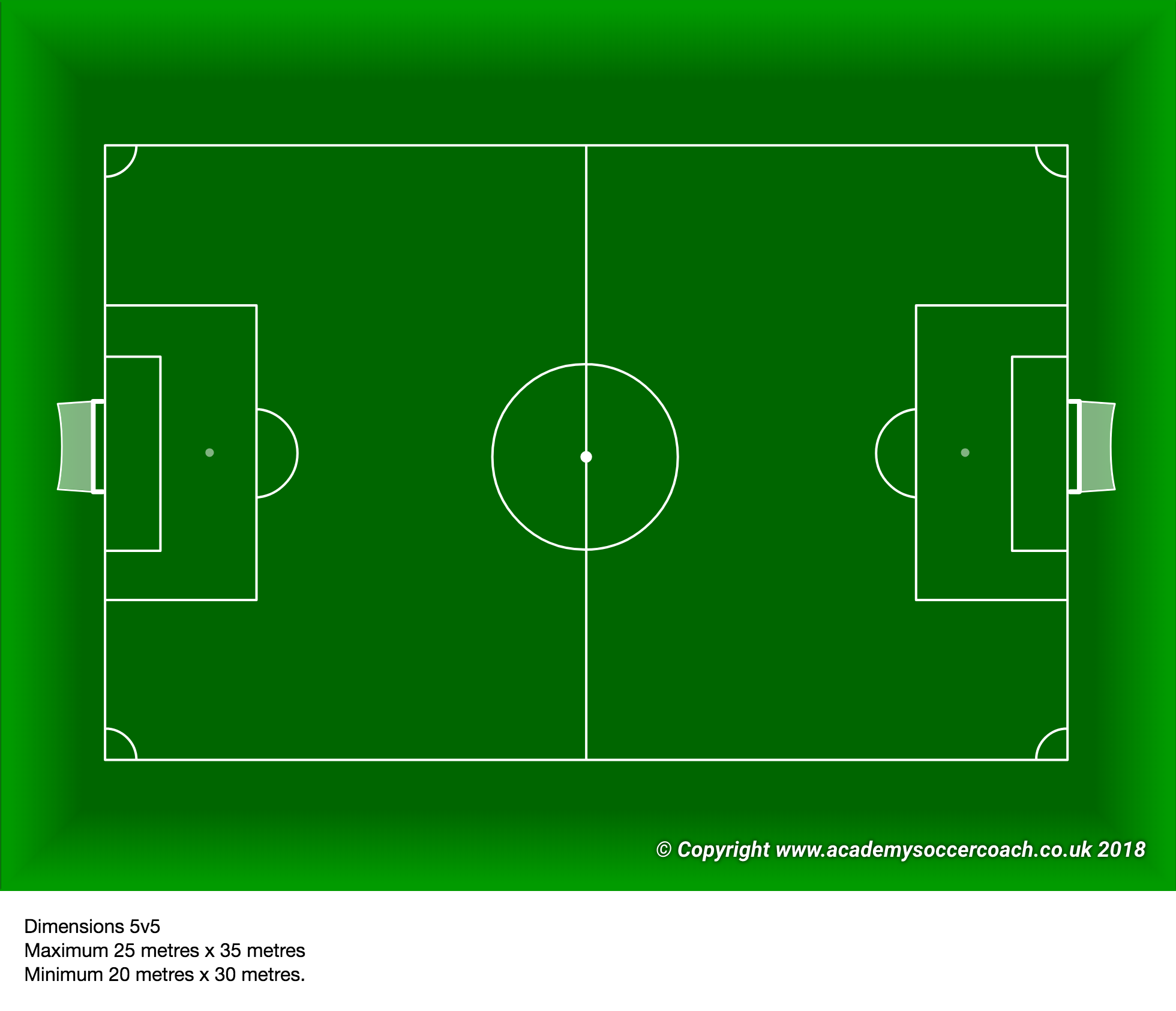
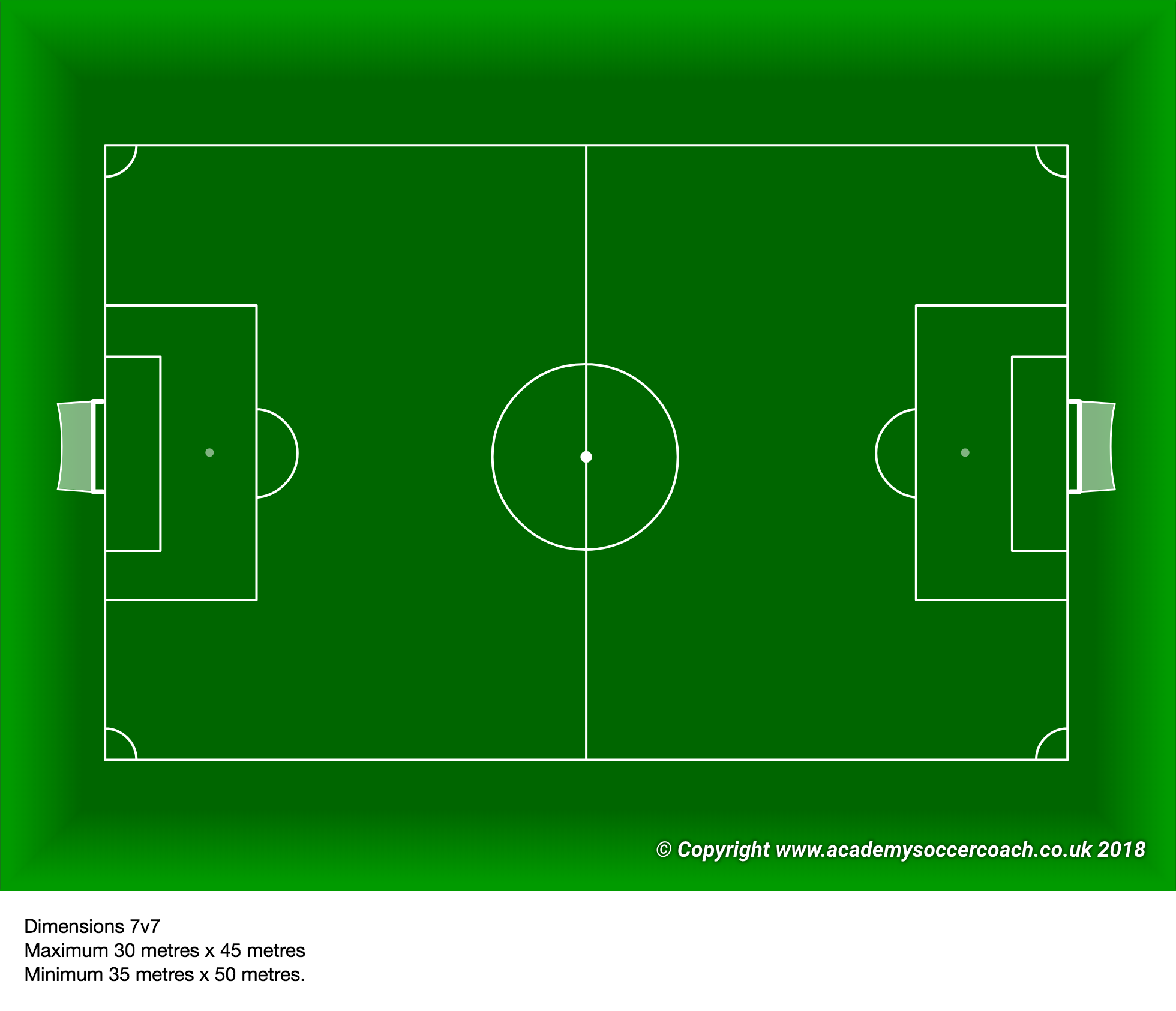
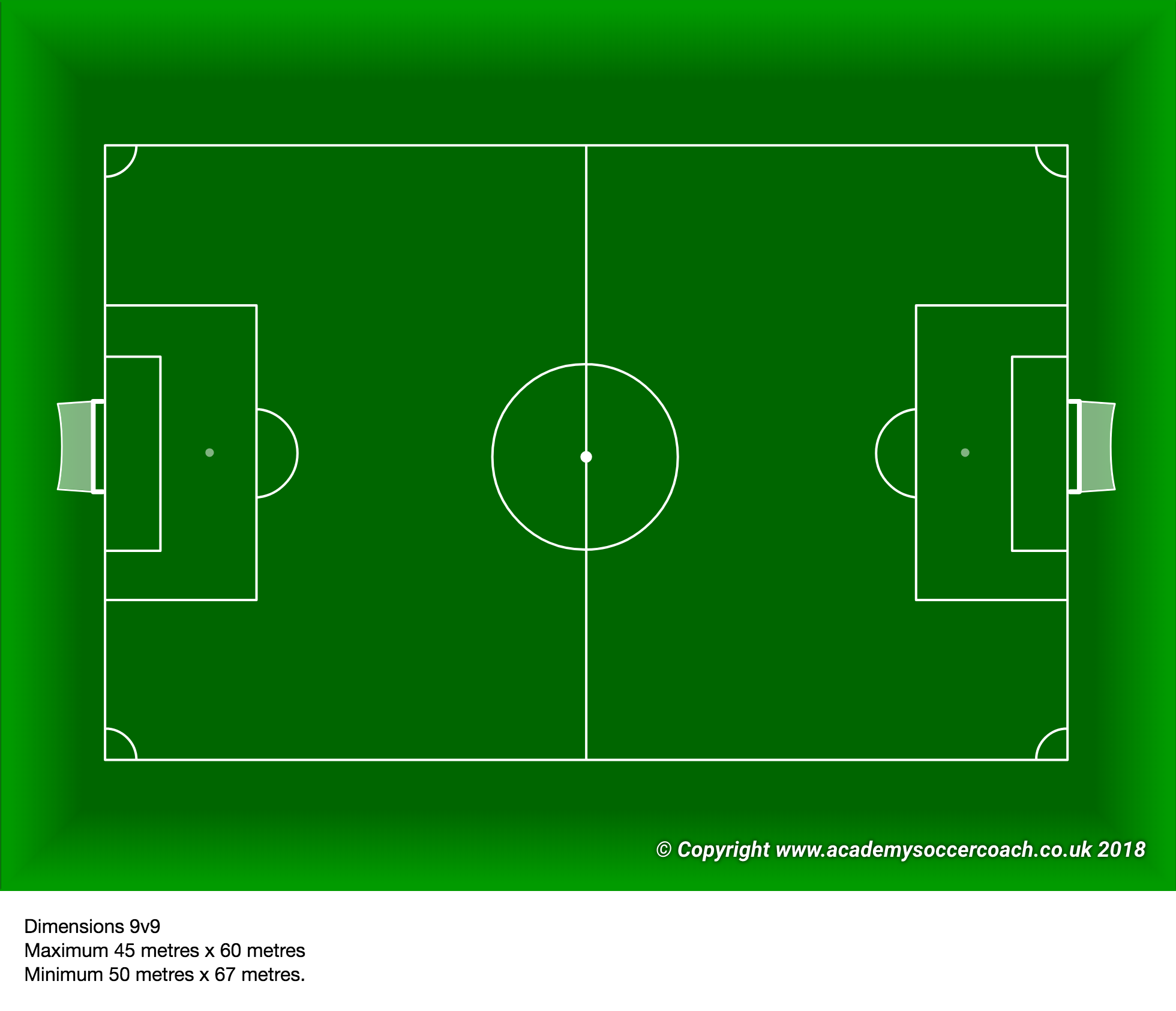
In junior football we have various forms that are used. The dimensions of these pitches are much closer to that of futsal, especially the 5v5 and 7v7 forms. There is also greater flexibility with regard to substitutions, with a rolling substitute format used, though the notification of the referee and stoppage of play is required.
The complexity of the fly goalkeeper may be too much for those playing 5v5 in grass roots football at under seven and under eight. This could also be true for 7v7 at under nine and under ten. The morality of having a specialised goalkeeper at such and early age and also replacing him with a specialist outfield player is questionable. It could result in the manipulation of the rules to bring the tallest player on for corner kicks or the player with the hardest shot on for free kicks. The reasons for using the fly keeper in futsal are generally to garner a positive result, the results at these developmental stages in grassroots football should not motivate any decision. On a 9v9 pitch the dimensions start to become challenging to the mobility of the goalkeeper.
This is not to say that the use of the goalkeeper as an extra outfield player is impossible. It just requires a little imagination and a little bravery.
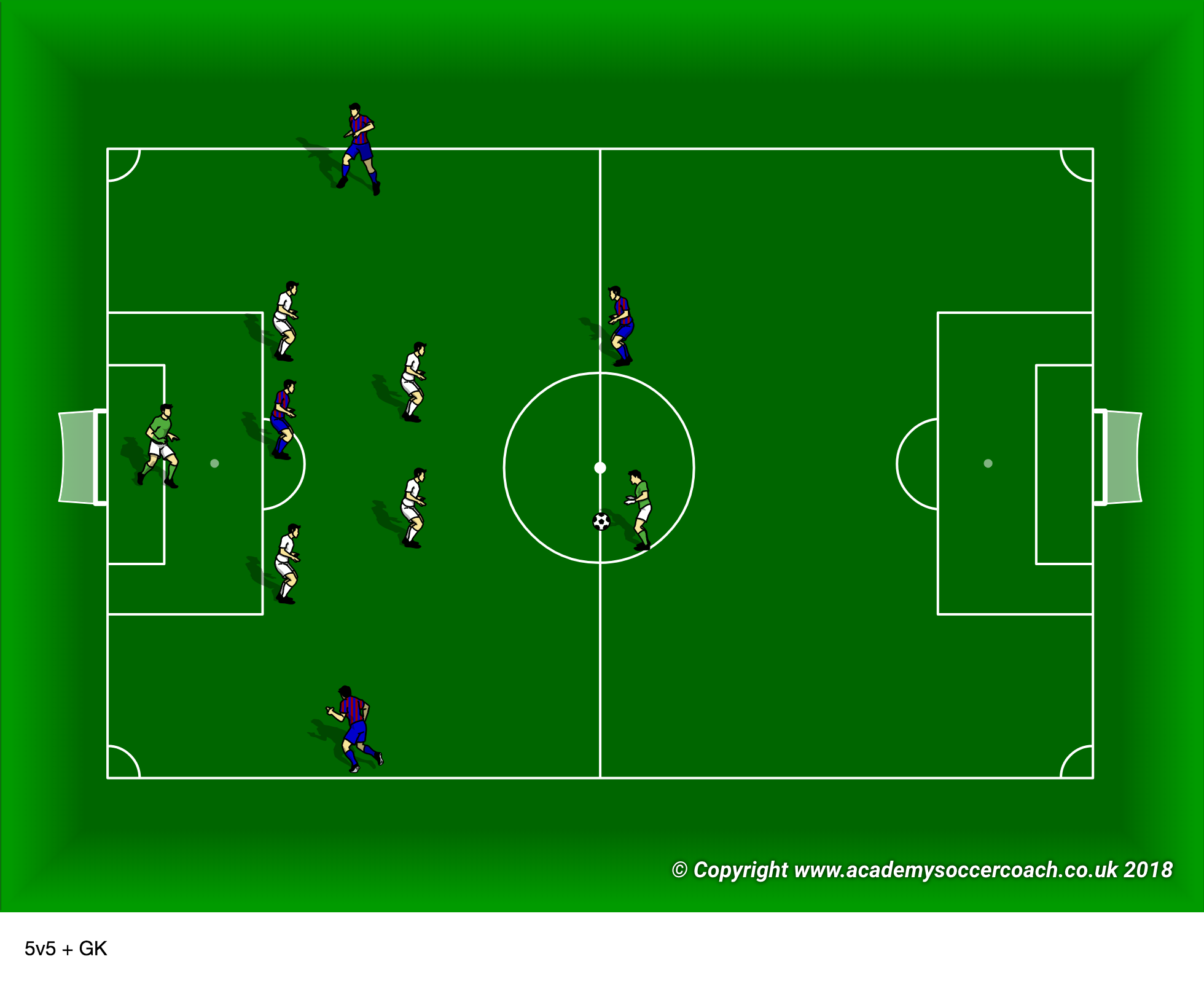
In a 5v5 match format the under 7 and under 8 players are unlikely to have a specialised goalkeeper. Even if they do, that child will need to spend time as an outfield player in order to develop his abilities with his feet. It is likely that the natural inclination of a child as young goalkeeper will be to stay stood on his line at all times, far from the rest of the game. We need to change that. The young goalkeeper needs to operate close to the edge of his box. Or even further forward. The sweeper keeper. Will a young child understand the concept? Possibly, possibly not. However they are likely to understand the idea of a rush keeper. The outfield player who can use their hands when they go into the area. Their position would therefore be of an extra defender whose first move is not to retreat back into the area but to move towards ball. Gain possession and stay on the ball (in the terminology of the England DNA). The goalkeeper is then free to attack as any outfield player might. My suggestion is not that under 7 and under 8 players will have long periods of possession as seen in the futsal examples but that the goalkeeper can be a recycler of possession or dribbler from deep.
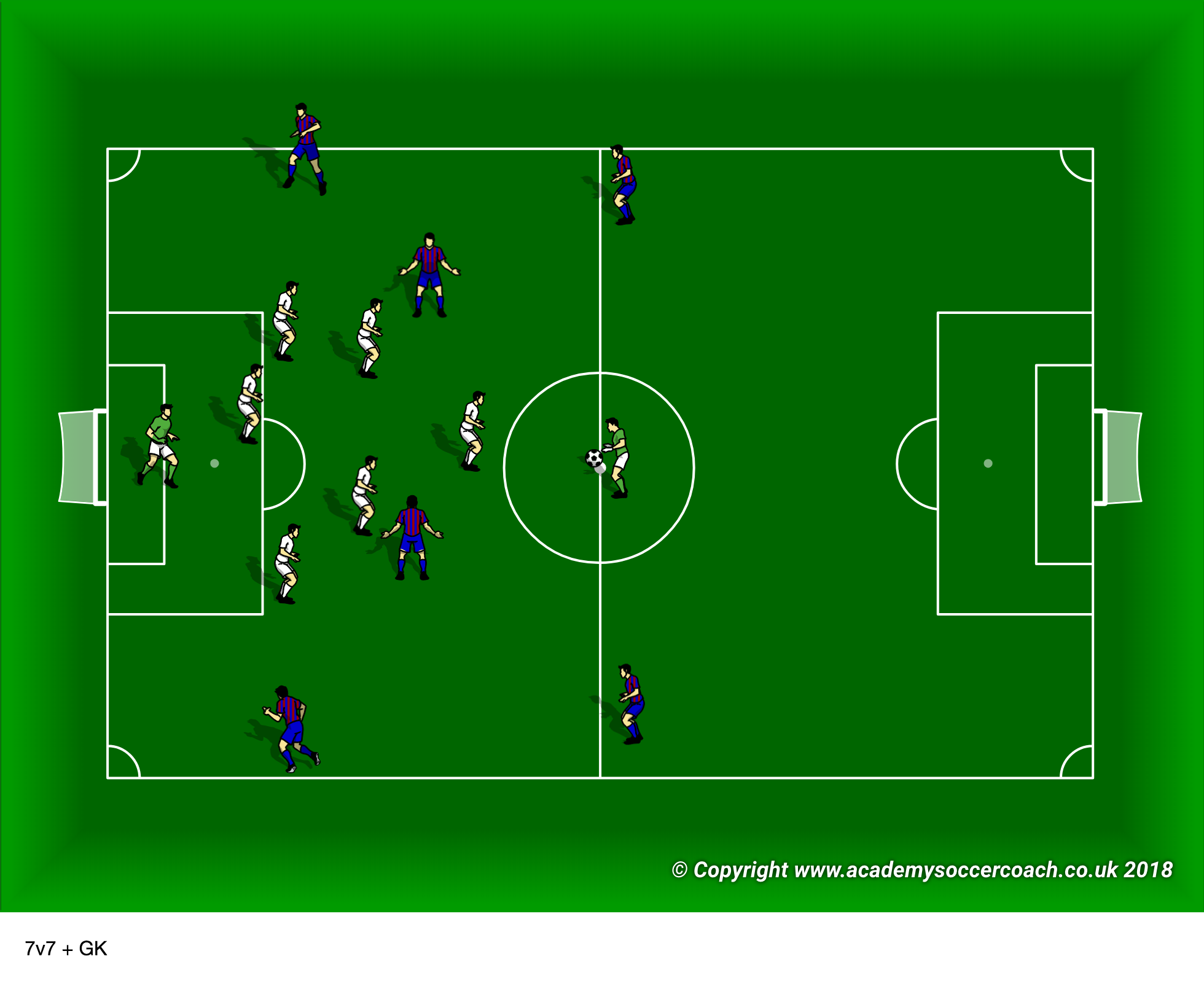
In 7v7 longer periods of possession may be possible as the players are older, however the key ideas of the role remain the same as 5v5. The distance back to the penalty area should be around 20 metres when playing 7v7, if team mates are able to close down the ball quickly enough most players will be able to get back into their area before there is a genuine threat on goal.
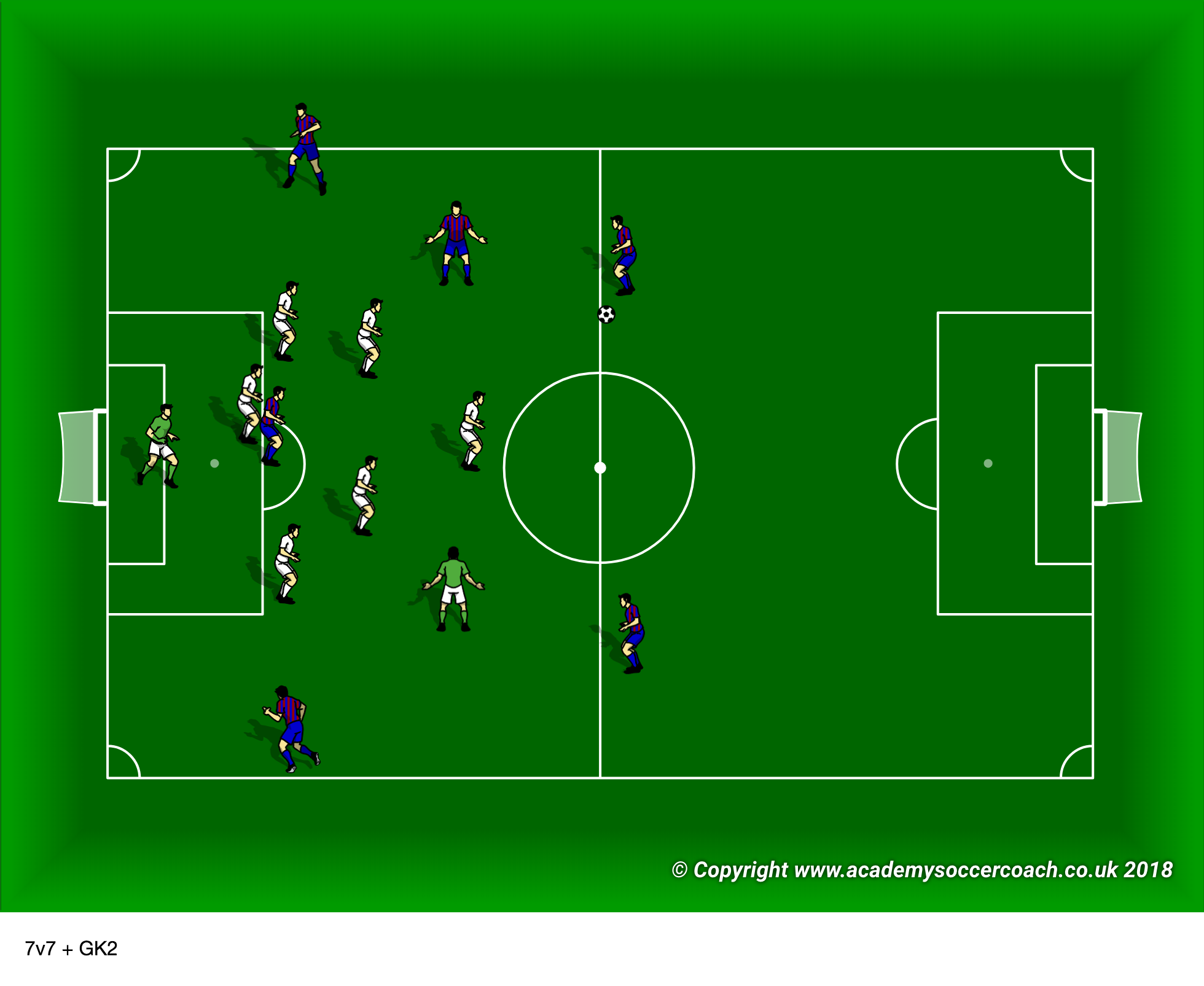
In 9v9 the area size makes this more advanced role more difficult, but we can still use the goalkeeper in the position of a deeper central defender when in possession. Or even as a quarter back in a pocket behind the play.
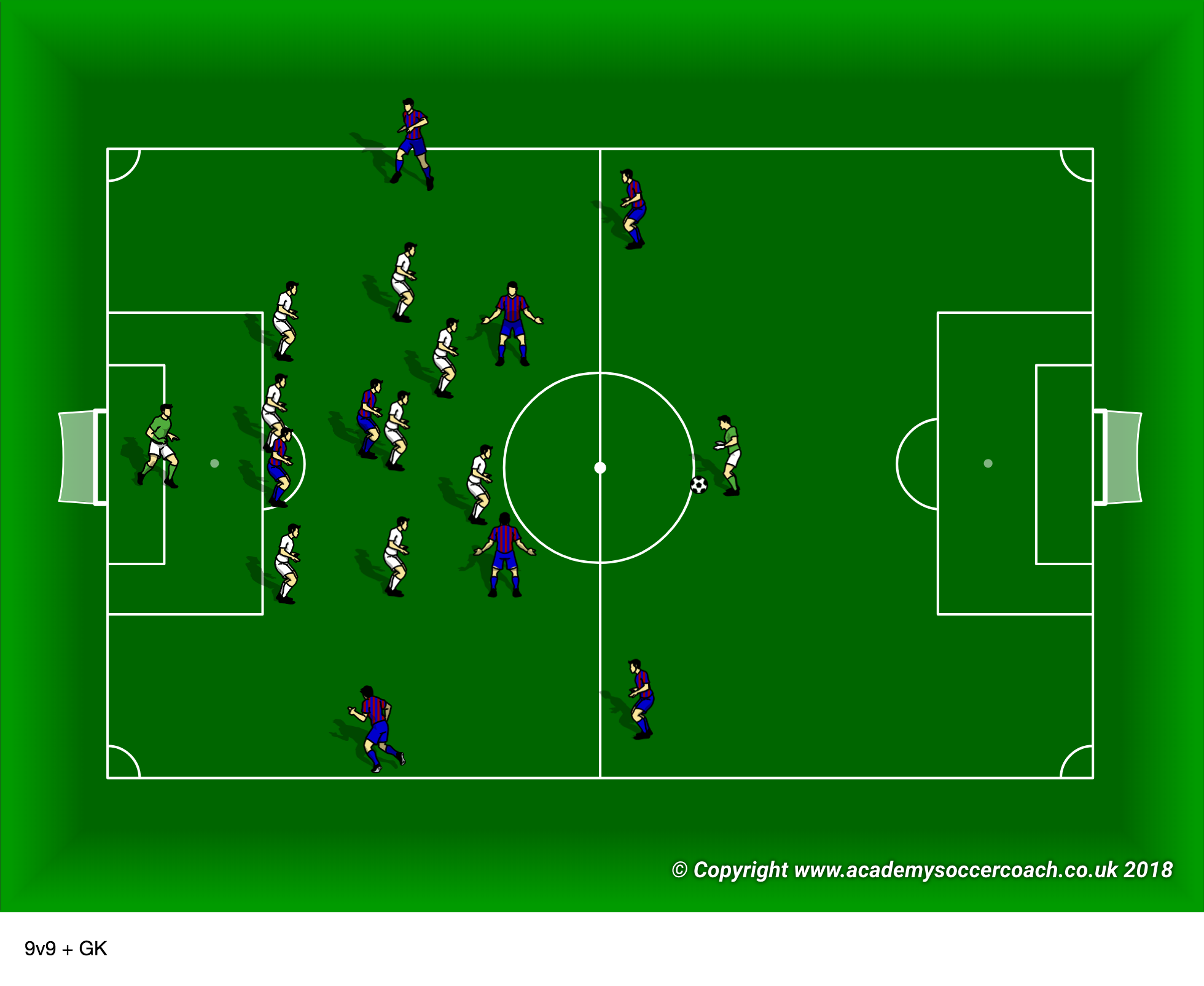
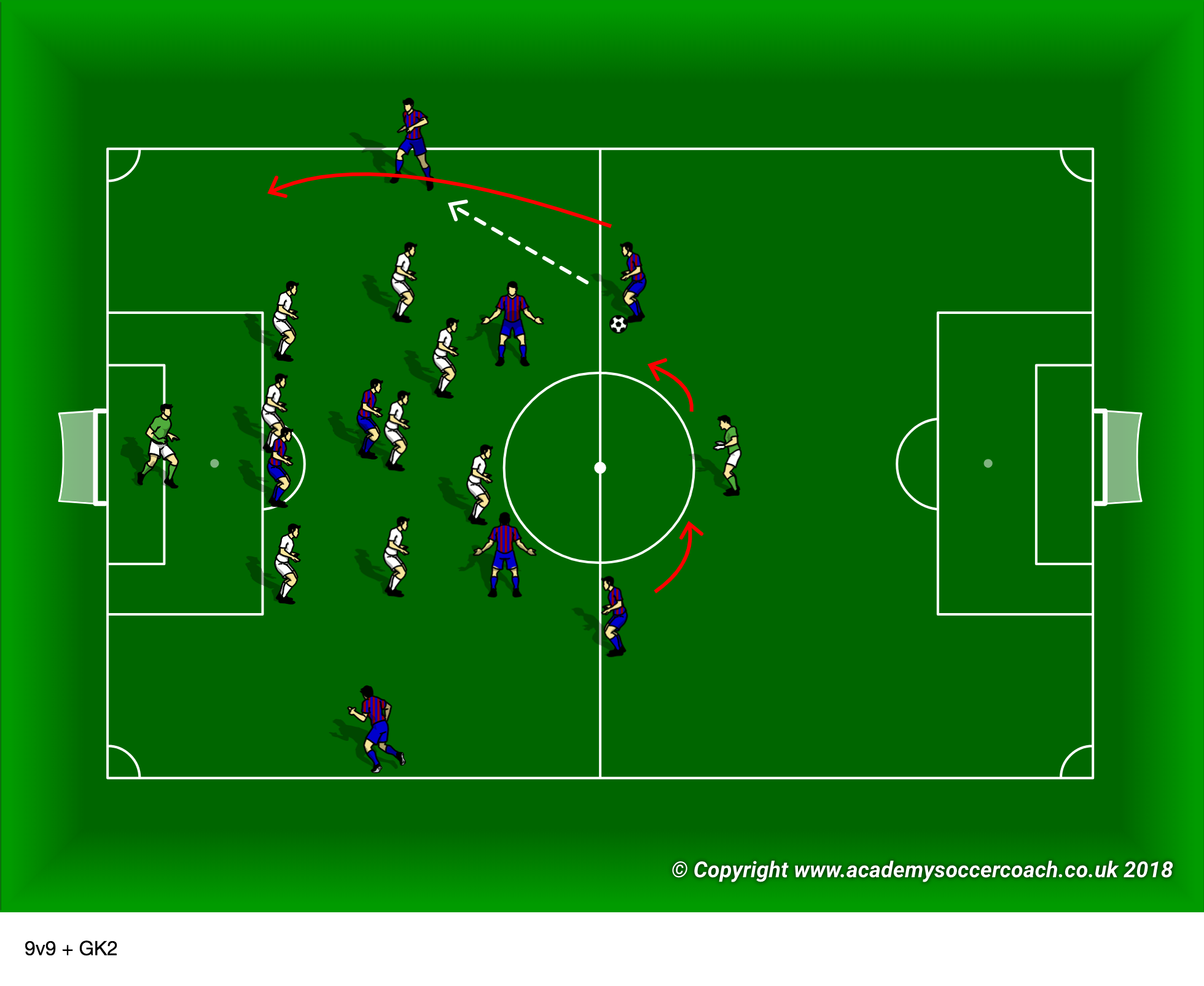
Many coaches (and indeed players) may not be comfortable with splitting the central defenders that far apart and leaving the goalkeeper to hold the centre. We can then tuck the two central defenders in a little tighter, making a triangle around the centre circle. The goalkeeper is still in a high enough position to join the play and a central defender might move forward to support if the attack is on his side of the field.
There are other lessons we can learn from futsal that are slightly less adventurous than those illustrated above. The goalkeeper can be an option on restarts that would allow over players to create space.
In futsal there kick ins rather than throw ins but the concept of spacing remains the same, especially for the smaller sized forms of football.
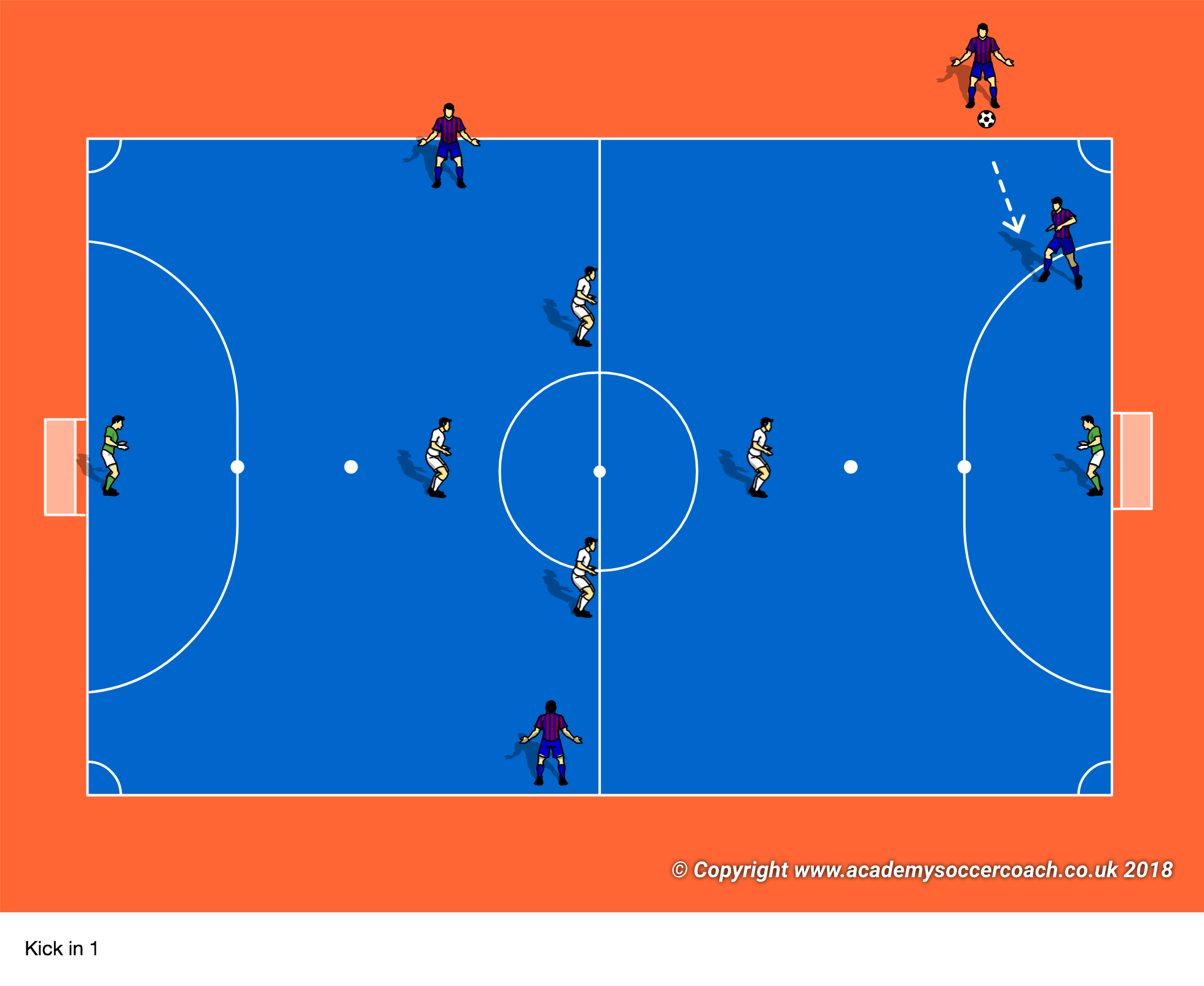
I would often see a set up similar to the one above. The player receiving the pass is being wasted. The pass could just as easily go to the goalkeeper and the player who received in that image occupy a different space.
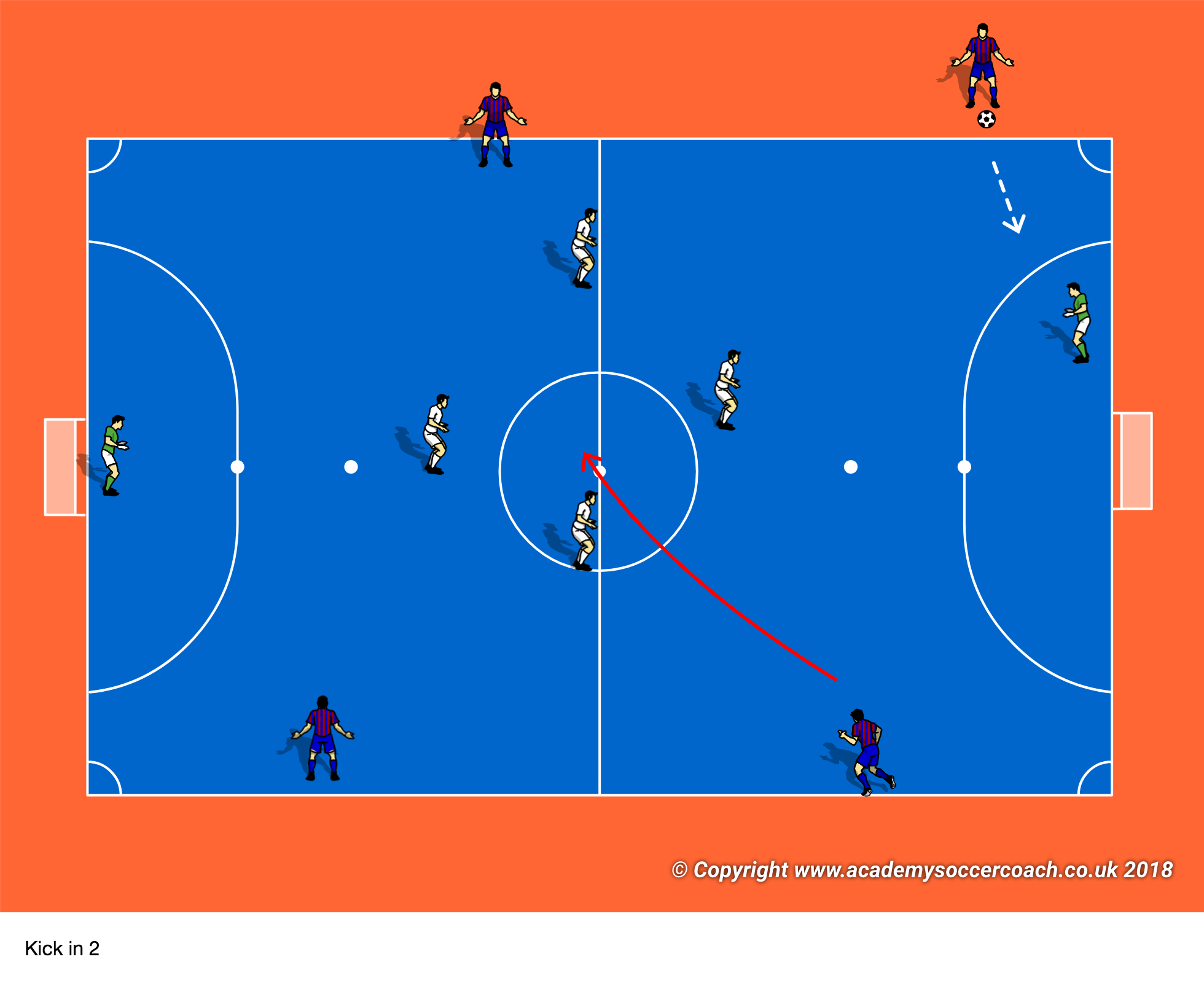
More than this, the goalkeeper can pull into the space on the opposite side of the court.
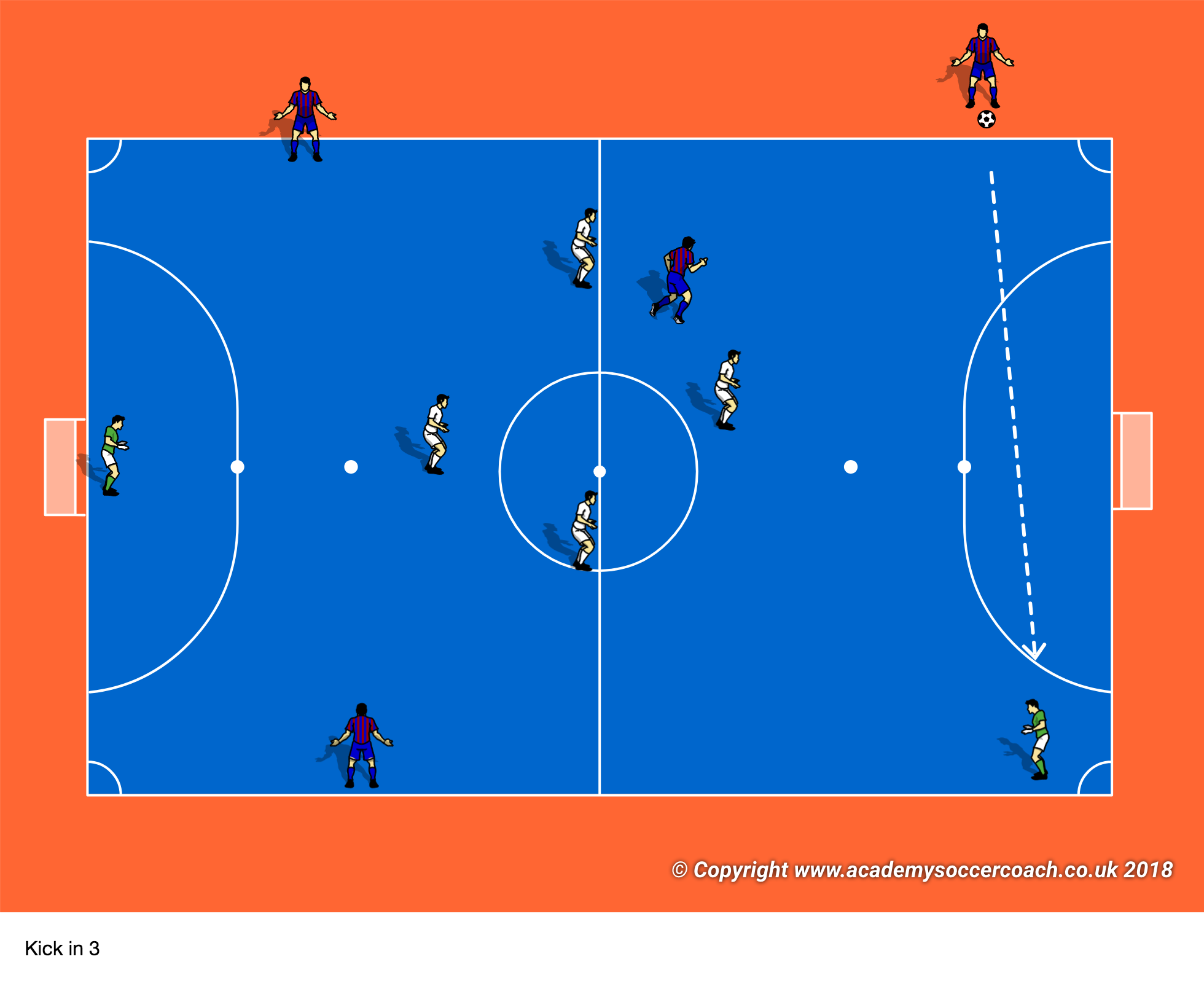
The team in possession would out number their opponents briefly but that time could be all that is needed to launch a decisive attack.
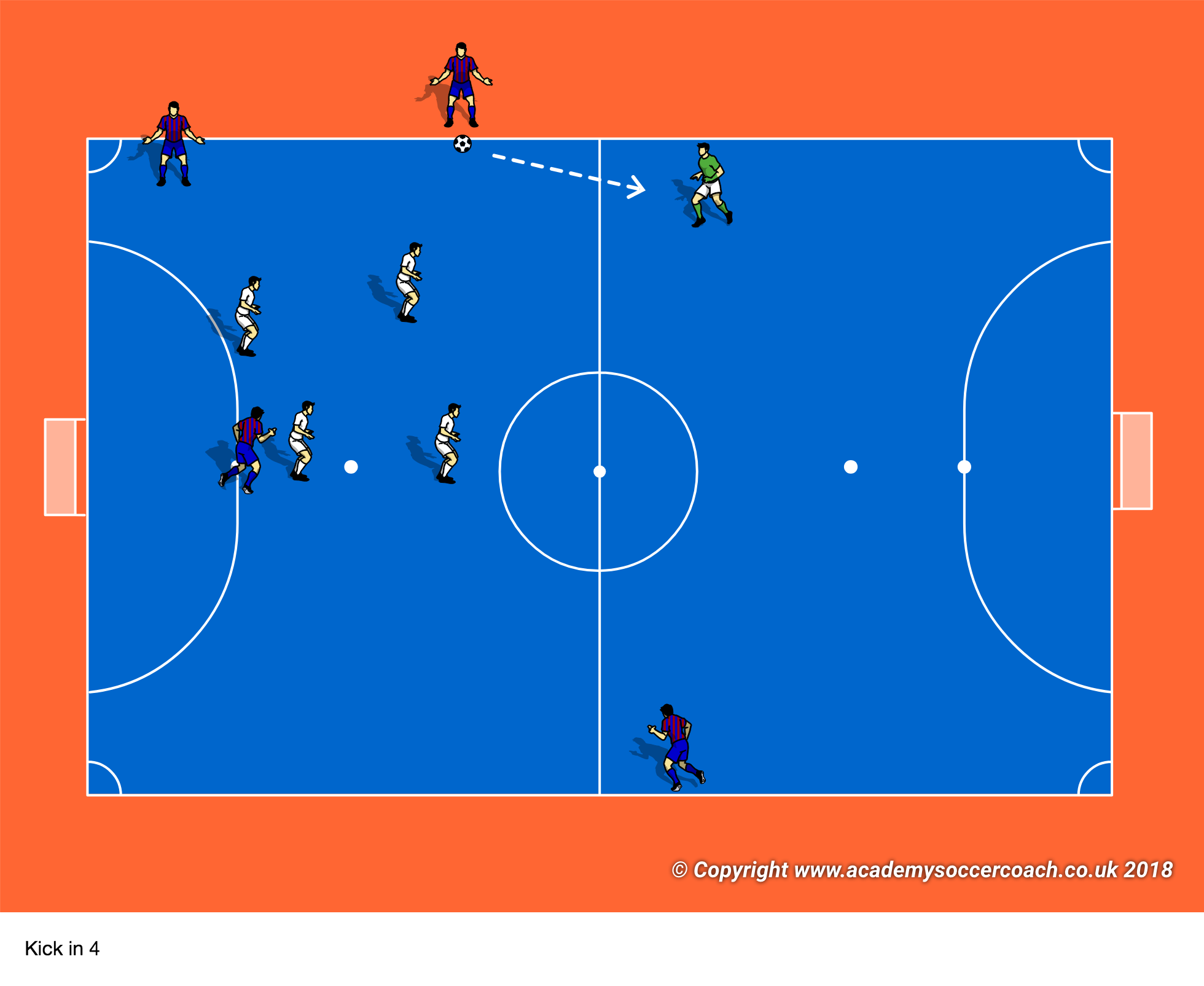
Similarly for a kick in higher up the court. The team momentarily takes up a position from which it would be possible to launch a fly attack. This also transfers into free kicks with the goalkeeper moving to support (after all in futsal a kick in is just an indirect free kick to the side of the court).
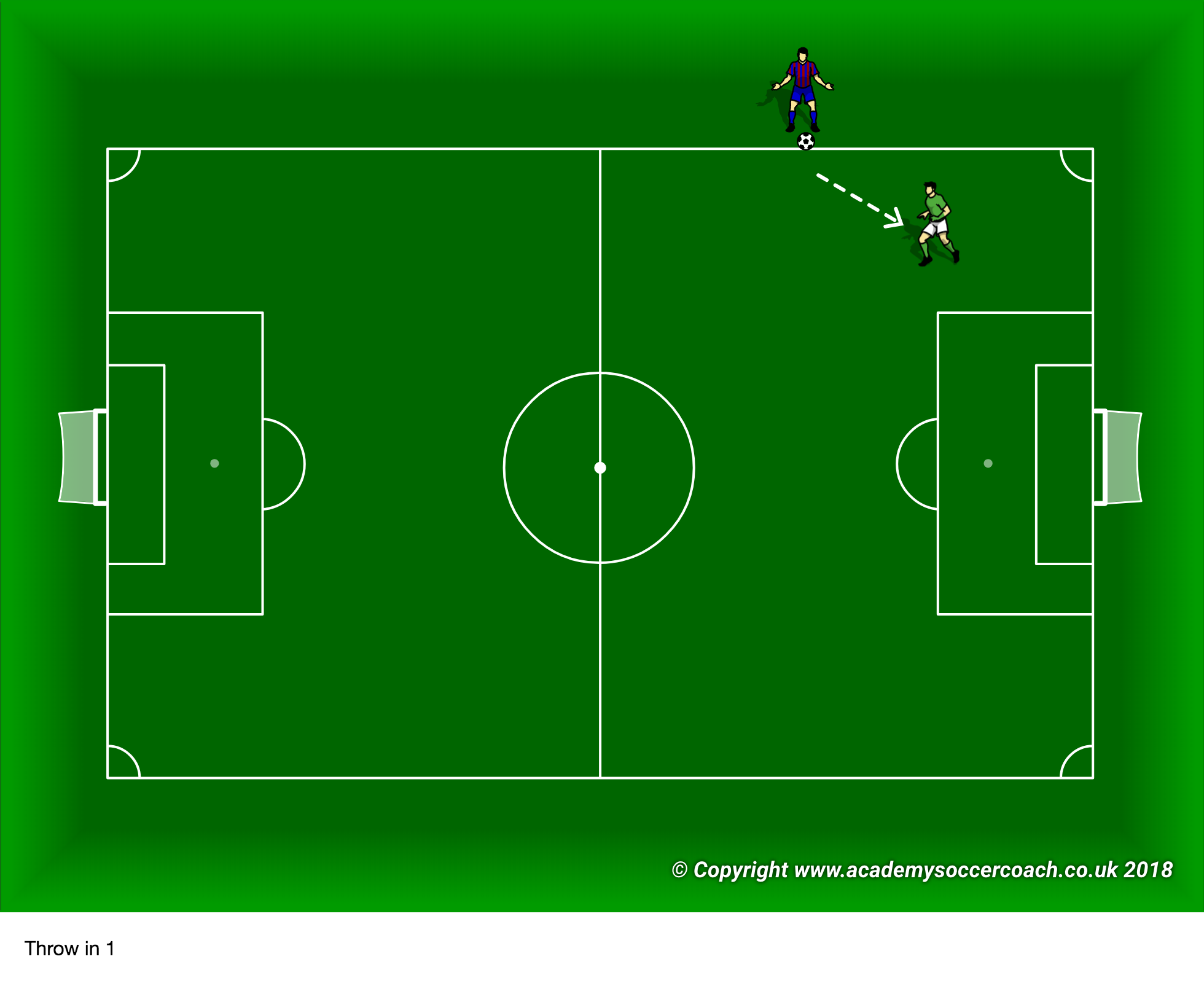
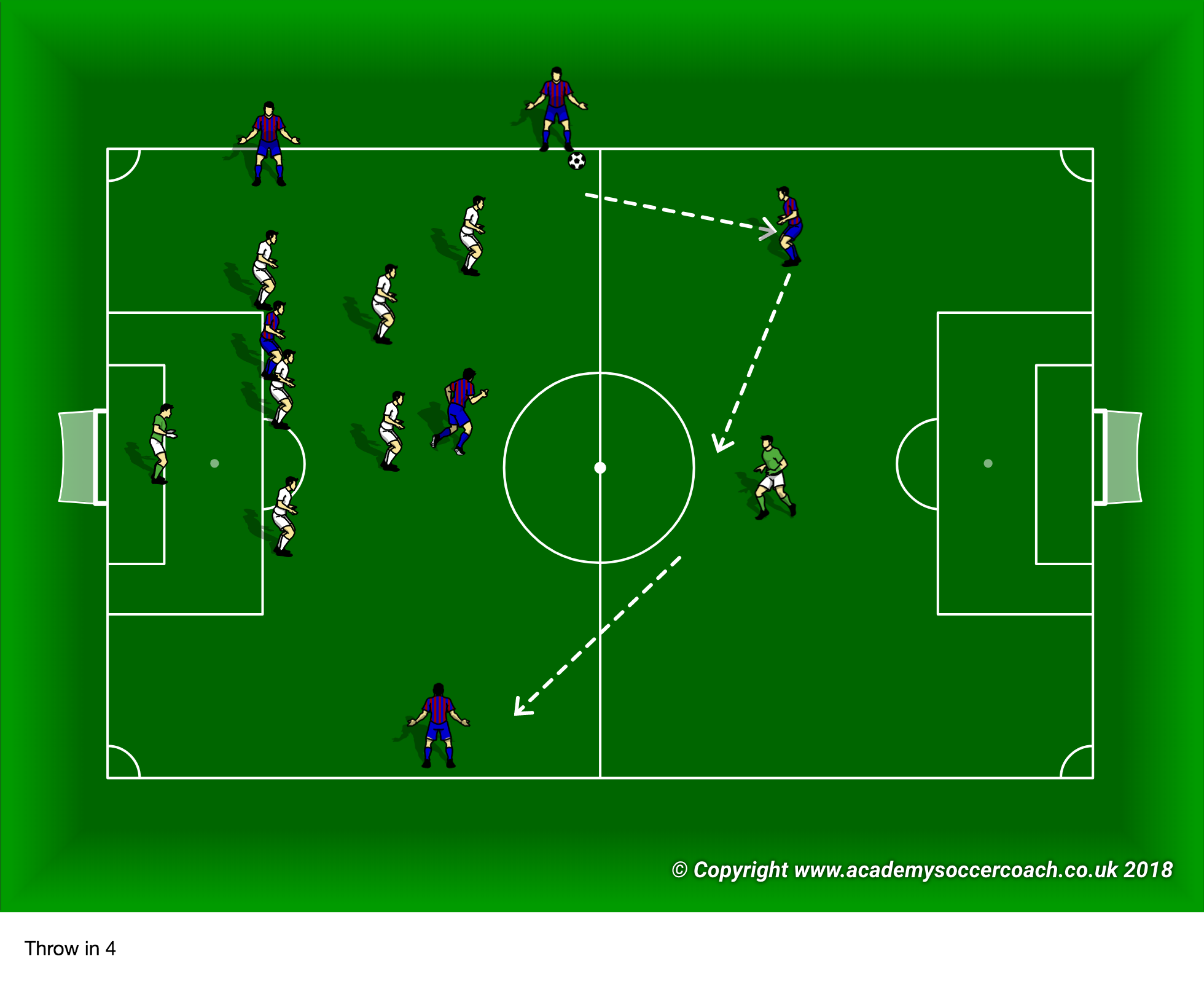
The concept of the goalkeeper offering support can easily transfer into football. Especially as numerically we are at a disadvantage when taking a throw in. With the thrower off the pitch and the goalkeeper away from the play opponents outnumber the team taking the throw. Though Cruyff said he wanted to take the throw ins because it meant he was the only player who was not marked.
If the goalkeeper is technically able to strike a cross field ball then that opens up further possibilities to create overloads with a switch while still occupying defenders on the near side.
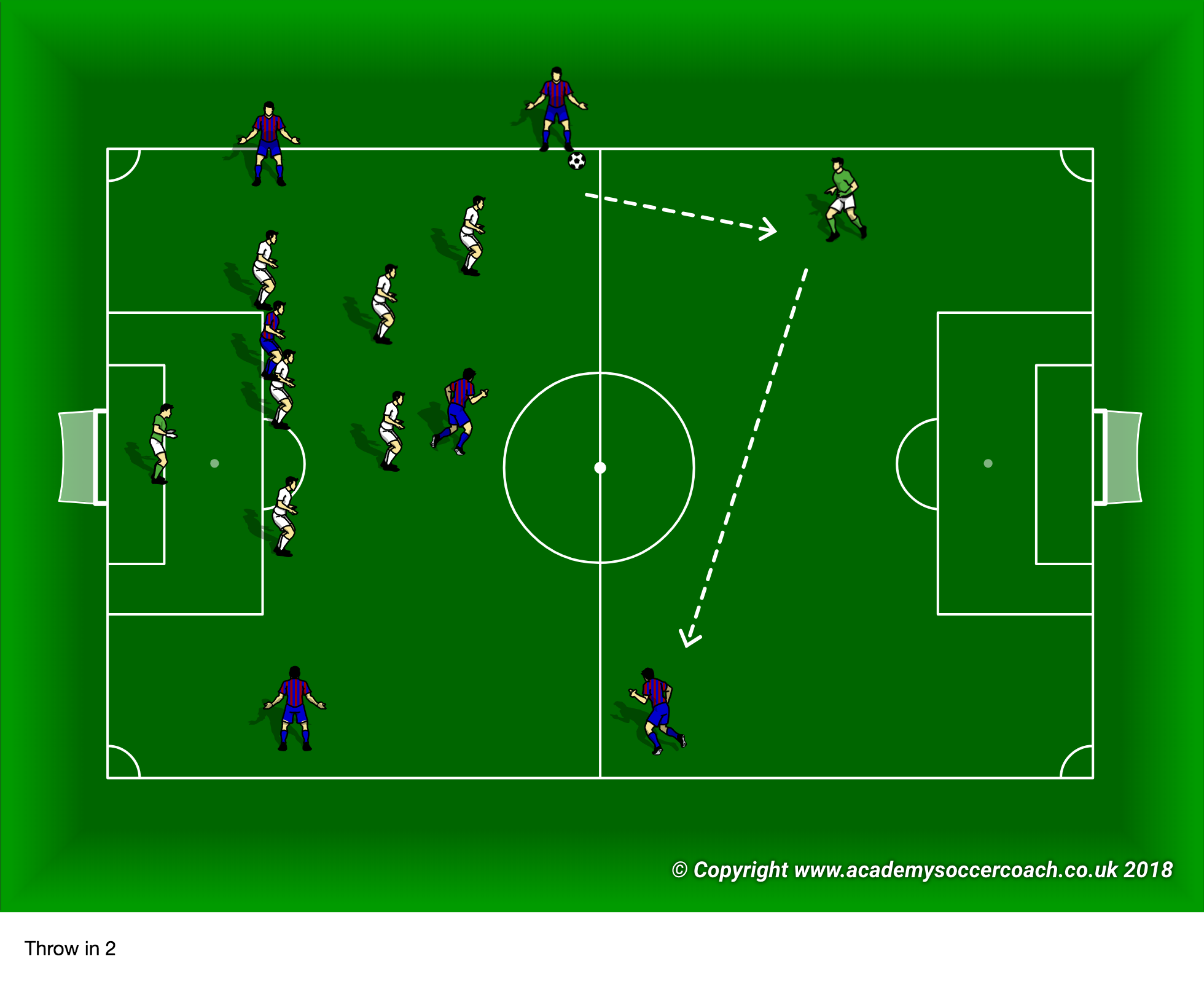
Even if the goalkeeper is unable to play the switch in one pass we can use a second player to switch the ball in two passes while still creating a 1v1 in the wide area.
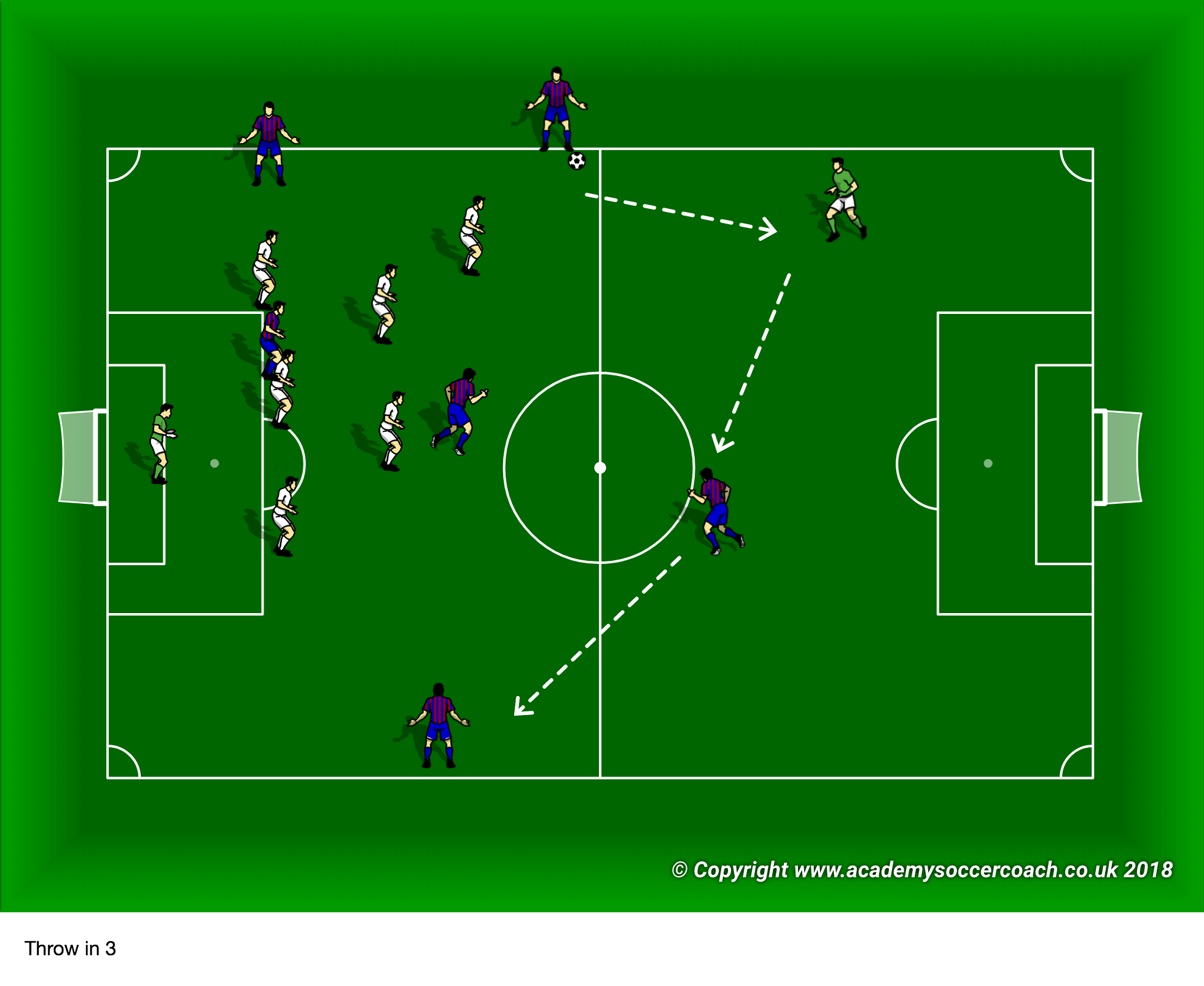
These set ups can be transferred all round the pitch. It does not have to be the goalkeeper who offers support closest to the ball, the goalkeeper could offer central support, but the core idea is that in moving the goalkeeper out of the confines of his area the game becomes more open for the team and the keeper.
No position has evolved as much in the last quarter century as that of goalkeeper. Ruud Gullit’s comment that a goalkeeper is only a goalkeeper because he can’t play football is now far from the truth. The goalkeeper has to be able to play. The goalkeeper has to be able to receive and pass in great comfort. Those who are able to dribble as well will have an either greater advantage. As the role of the goalkeeper continues to change we need to change our thought processes around the goalkeeper. It is far from the safety first position it once was.
The goalkeeper truly is the first attacker in the modern game.
How often is this the case in youth football?
More attacking use of the goalkeeper is required. This will match with the game we watch the professionals play but also may encourage more children to play in goal. The knowledge that they are not imprisoned within a box but have the freedom to play just as much football as any of the outfield players. Psychologically they will surely feel more valued and more a part of the team. It can be very lonely being a youth team goalkeeper.
Hands are without a doubt still vital to the goalkeeper. After all these are their great advantage over the outfield player. Until recently though the outfield player held a great advantage over the goalkeeper. Superior foot skills.
This can and will change. If we are open minded and brave.
Very brave.
As brave as a goalkeeper.