Within business companies will bring people in to help rediscover lost creativity. The non creative types who have lost their creative capacities. There are people who specialise in these activities and they have numerous techniques to draw the creativity out. Often they are met with resistance. As they have grown up practicality has replaced imagination. This first barrier often needs breaking down.

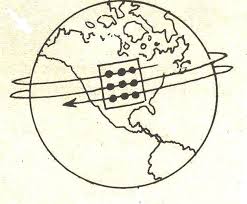
One task used to break down this first barrier involves the above nine dots. The task is thus; Join all nine dots using no more than 3 continuos straight lines. The answer requires a ruler and a little thought.
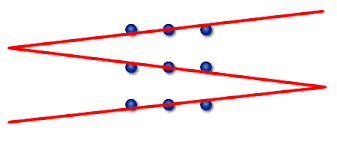
To answer the problem people have to free themselves of the limitation of the page and the limitations of a set way of thinking, once shaken off it becomes possible to answer the puzzle using a single straight line.
Gita Langston of GL Connects shared a number of methods and exercises (including the nine dot puzzle) with me.
Rather than asking people to brainstorm ideas on how to sell more of a product they will ask the opposite. The business will be asked to come up with ideas to ensure that they never sell another unit again. No matter how bizarre the idea it is written down on a post it note and placed on a board. Then in groups two or three of these post it notes are taken down with task now being to counter the idea, thus a selling technique is born or solidified.
With more senior and experienced people they like to take them back to childhood. With glitter, glue, scissors, magazines, felt tips and pencils they are charged with making a collage. The title of the collage will be whatever the client is looking to be creative about.
Stories are also used. Once upon a time stories when work spaces are being created. When these are being written “what if?” questions are used. What if this space was a castle? What if a bear was in this space? How would you keep it out? How would you keep it in? What if you were this bear?
There are many other ideas and methods utilised. The common thread is that they are open ended and playful. Very playful.
And this is the dull grey world of business.
The multitude will associate creativity with the arts. With film makers, sculptors, actors and writers. We have all heard of writers block, so we must all understand that the creative switch is not always on, even for “creative types”.
How do they find their creativity?
Ealing artist Nicola Gaughan described her process.
“It’s all about imagination, day dreaming, visualising ‘stuff’. I see it in my mind’s eye, listening to the subconscious. Meditation can help with this, as can reading and looking at images.”
“More importantly you have to feel the fear and do it anyway. Not being scared of being wrong and being prepared to do something anyway, even if you or someone else think it is wrong or doesn’t look right. Have confidence in your ability, believe in yourself and your creativity.”
“Feed this creativity. Watch films, read books, go to gigs, meet new people, listen to new music, visit new places. These will help spark new ideas.”
However, as Sir Ken Robinson said being creative does not mean that your ideas have to be wholly original and new to the world. A new take or spin on something pre existing can be more than enough to inspire.
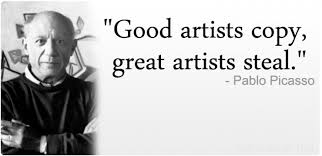
Or
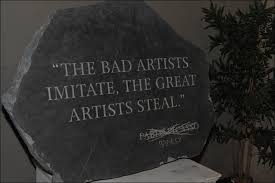
Picasso was far more methodical than one might at first imagine. He had five core pillars to his artistic philosophy that guided his work.
Radical Constraints
“For a long time I limited myself to one colour as a form of discipline” – Picasso (in reference to his blue period)
By using constraints Picasso forced himself to come up with solutions to problems. This method is echoed in Scandinavian cinema, with the Dogme 95 methodology. Lars von Trier and Thomas Vinterberg produced ten rules to which dogme cinema had to conform in an effort to avoid over production and better connect with audiences.
- Shooting must be done on location. If a particular prop is needed a location with this prop must be found.
- The sound may never be produced apart from the image or vice versa. (Music must not be used unless music occurs on the location where the scene is shot)
- The camera must be hand held.
- The film must be in colour. Special lighting is not acceptable.
- Optical work and filters are not acceptable
- The film must not contain superficial action
- The film takes place in the here and now
- Genre movies are not acceptable
- The film format must be 35mm
- The director must not be credited
Total freedom can be intimidating. By adhering to a set of rules Scandinavian cinema experienced an artistic rebirth.
Ruthless Reduction
“Every creation is first an act of destruction” – Picasso
By taking something complex and simplifying art and innovation can be created.
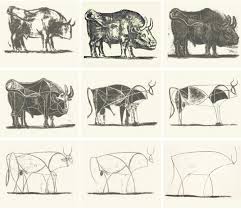
Continuos Iteration
“Action is the foundational key to all success” – Picasso
Picasso was a prolific artist (as was van Gogh). Rather than being protective of ideas and awaiting perfection he simply got on with it. Churning out works. If it wasn’t good enough, Picasso just did it again.
Motivating Competition
“Only one person has the right to criticise me. It’s Picasso” – Matisse
“All things considered there is only Matisse” – Picasso
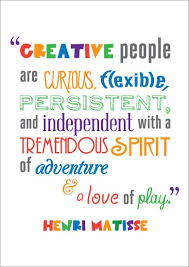
The competitive rivalry spurred these two great artists on. It has often been the case. In the 60s The Beatles success pushed The Rolling Stones. Upon hearing The Beatles album Rubber Soul songwriter Brian Wilson was inspired to write Pet Sounds, the classic Beach Boys album. In tennis McEnroe and Borg pushed each other to ever greater levels in the late 70s and early 80s and now that effect has been amplified by Federer being pushed by Nadal who was then pushed by Djokovic who was then pushed by Murray. External motivations can be exceedingly powerful.
Contrarian Experimentation
“Anything you can imagine is real” – Picasso
This final point takes us back to the methods used to free the mind of the societal manacles. Being deliberately contrarian can lead the brain into numerous interesting places.
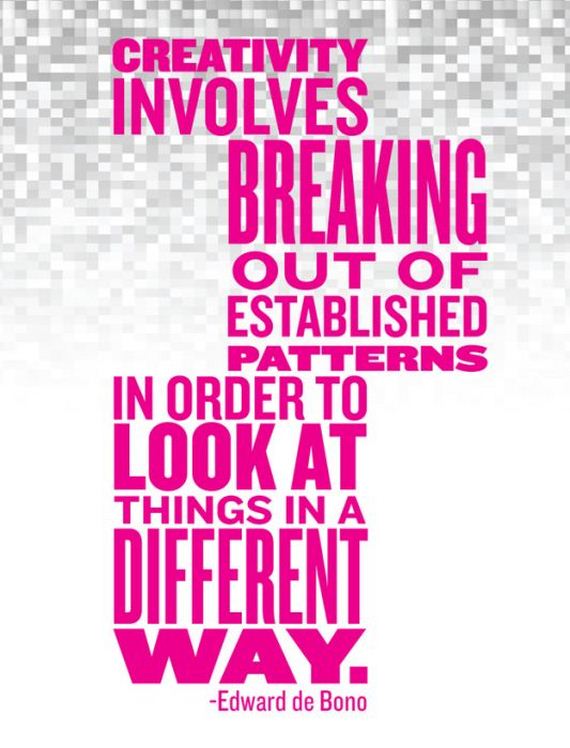
Picasso understood that creativity needs prompting and developed methods to help lure it forth. A box of tools at at his finger tips.
In music Brian Eno has chased usable tools throughout his career. Beginning with his time with Roxy Music and then as producer extraordinaire for David Bowie, U2 et al. Many turned to him when they needed a creative muse. Eno has his own check list of methods.
Freeform Capture
Drawing from a range of sources then linking them together. Brian Eno keeps a a microcassette recorder to hand at all times to gather up any and all ideas that come to him.
Blank State
Start with nothing. No preconceived ideas. In musical terms this might be described as “jamming”. Eno will often only have the musicians and a few instruments. They will “toy” with the instruments until a texture or emotion emerges to guide the process.
Deliberate Limitations
Picasso, Dogme and Brian Eno would seem to be in agreement.
“This piece is going to be three minutes and nineteen seconds long and it is going to have changes here, here and here, and there is going to be a convolution of events here, and there’s going to be a very fast rhythm here with a very slow moving part over the top of it.”- Brian Eno
Opposing Forces
At times the forced blending of ideas can produce outstanding results. By bringing together artists who would not usually work together a fresh approach will be created.
Creative Prompts
While with Roxy Music in the 1970s Brian Eno developed “Oblique Strategy Cards”. These are prompts designed to trigger the mind into a different direction. Examples include;
- Try faking it!
- Only a part, not the whole
- Work at a different speed
- Disconnect from desire
- Turn it upside down
- Use an old idea
Brian Eno wanted to be able to apply his methods. As a guiding figure his role is to enhance the creativity of others. A modern muse.
This role is precisely that of the youth football coach. If we want to develop creative footballers, with the ability to solve problems in ways that others would never imagine, we have to act as their muse.
Leaving one small, unanswered question. If they can do it, how can we do it too? How can we use the creative processes that have been such a success in other walks of life in our sport?