“Why?”
This was a difficult question to answer.
“It doesn’t work.”
Rebellion. The under 14s did not agree with my thinking. They felt that tactically they knew all they needed to. That they had seen it with their own eyes. Three at the back did not work. Three at the back was bad. Their minds were made up. Whatever I was selling, they were not buying.
As our season wound down in May 2014 I made my decision. The squad was full of players who wanted to play in midfield or attack. There were some boys grumbling about playing games in defence and thinking about leaving because of it. My solution was to remove a defender, switching to a variation of 3-4-3/3-5-2. The players liked the idea and the reasons for it. In May.
On June 13th 2014 the plan gained more credence. Louis van Gaal’s Netherland’s team won 5-1. Against the reigning world champions. The great Spanish team that had won three major tournaments in a row beaten by a team playing three at the back.

Suddenly a seemingly forgotten and discarded tactical idea is back in vogue. Harry Redknapp declares that he is bringing in Glenn Hoddle to help QPR transition to a back three based formation. Louis van Gaal is set to transform Manchester United by implementing his 3-5-2 and add greater tactical flexibility to English football. In June.
Fast forward a couple of months. Manchester United have made a poor start to the season. The three man defence blamed for creating uncertainty. At QPR they drop the three man defence quickly and return to a four man defence following heavy defeats.
My team start the season with a lovely passing performance and a 2-2 draw. Then came a cup loss and a cup win. Then the goals started to fly in. At our end. The team were playing some nice football but conceding goals. The players blamed the formation. My points about taking time to learn the formation fall on deaf ears. A month after Manchester United reverted to a back four, we did the same. The players “won”.
Louis van Gaal’s revolution lasted around four months. It appeared that this particular cycle of three man defences was at an end.
The first cycle I can recall is where I got interested in football tactics. In the mid 1990s a number of teams played 3-5-2 in the Premier league. This eventually extended to the national team, in myth Terry Venables in 96 and actually Glenn Hoddle between 97-98.
The team that really interested me were Liverpool. Roy Evans quickly implemented a 3-5-2 after taking over from Graeme Souness. The three in central midfield consisted of John Barnes, Steve McManaman and Jamie Redknapp. Two wide players and a ball player. Not a fierce tackler to be seen. At the time Liverpool didn’t have one. They hadn’t had one for years. Attempts to bring such a player in had reaped poor results. Roy Evans had a solution. Remove that player. Liverpool also had a disproportionate number of players who could operate in central defence at the time. John Scales, Phil Babb, Mark Wright, Neil Ruddock and Steve Harkness. None had been able to operate as a successful pairing, their attributes failing to gel. Liverpool used 3-5-2 as a solution to two problems. Defensively it combined the attributes of three players to find solidity where two had been shaky. The extra lock at the back allowed three flair players to flourish together in midfield, masking a lack of bite. Evens took Liverpool close to the league title, but the lack of midfield bite was blamed for Liverpool not making that last step. Paul Ince signed, the team returned to the English tradition of 4-4-2, results fell away and Roy Evans lost his job. Though Aston Villa kept the three man defensive flag flying for a while they eventually returned to a back four and the cycle ended.
This was until Italian football took up the baton (though Croatia deserve an honourable mention). The back three made a splash over in Serie A. This was not 3-5-2 though, it was 3-4-3. The apex of this coming, like the Dutch, against Spain during a major tournament. There central defenders suited the Italian psychology. Cateneccio locks up Italian defences (and Italian minds, Arrigo Sacchi had to fight hard to get a back four accepted in the 1980s). A libero is sacrosanct to the Italian footballing tradition. In his book Denis Bergkamp talks about his experience at Inter. The team was split into defenders and attackers. There was effectively no midfield. Seven players kept the door shut. Three attackers had to work their magic. A 3-4-3 fits with that mentality.
However, Cesare Prandelli did something slightly different in that game against Spain. Something quite Catalan. He deployed central midfielder Daniele De Rossi as one of the three man defence.
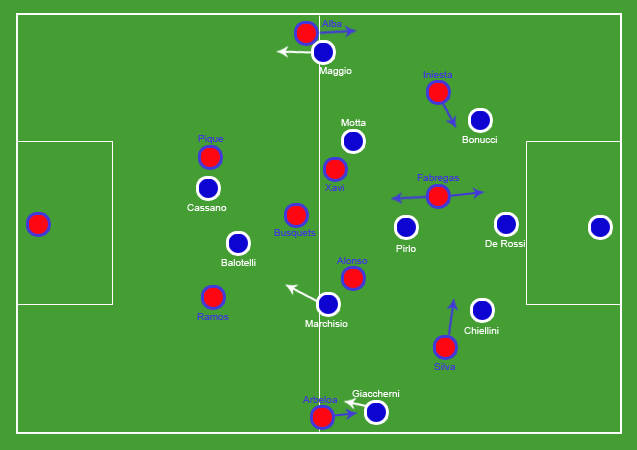
In 2010 Pep Guardiola signed Javier Mascherano from Liverpool. The hard tackling, short of stature central midfielder became a central defender. A player who understood the game well enough to read defensive scenarios but also could pass the ball with high quality. It was precisely this reasoning that lead to De Rossi playing in central defence. The lines between back four and back three start to blur.
“You are constantly in and out of systems.” I quoted Jamie Carragher to my players. Their faces asked me what the hell I was on about. This really was a tough sell.
Players don’t really play in positions. They play in areas. Zones. Zone 14 has been a popular reference point in the last decade as England search for their Totti, Bergkamp or Zidane. Positions are labels we give to players who tend to occupy certain zones. The more tactically flexible a system, the less these labels apply. When the footballers are versatile and highly skilled the differences between central defender and defensive midfielder, full back, wingback and winger become exceedingly fine.
Sergio Busquets is a prime example. For Barcelona his face appeared in midfield positions pre game. On the field he continually dropped into central defence or very close to the defence, creating a triangle in possession. This extra shield allowing the full backs to push on and become wing backs or even wingers in the Barcelona system. In possession the positioning of Busquets meant that in possession Barcelona played with a back three. In and out of systems and not just at Barcelona. The key for teams is not really the formation, it is the shape.

Take the image above and you have the basic shape, maybe moving the top player back a few squares or the last player forward a few squares, of most successful teams of the last twenty years. Perhaps even longer. After Liverpool beat Manchester City 2-1 Graeme Souness talked about the way Liverpool played when he was in the team. As a midfield player he dropped in alongside the central defenders, pushing the full backs in to midfield and outnumbering the opposition. This was in the late 70s and early 80s. Ajax and the Netherlands went in the opposite direction with a central defender stepping out to create an extra midfielder and the remaining three defenders creating a triangle.

The key to football is to outnumber the opposition in midfield but also maintain width. Whether that is written on paper as three at the back or four at the back is not important, that is just paper. Three at the back has tended to be an answer to a problem. No good defensive midfielder? Use an extra centre back. No good full backs? Use wingers instead and give them extra cover in behind. The 4-3-3 and 3-4-3 overlap through the movement and positioning of a central pivot. The difference can be as little as 10-20 yards and the classification shifts from one formation to another.
On the weekend of the 7th of March I drew a 3-4-3 system on the board. The players nodded and were happy. Not because we had practised it. Not because we had different personnel. But because they had seen how it can be succesful in the Premier League. A team who had not set out to play three at the back at the start of the season. A team who had used a back three to solve a problem. Once again we look to Liverpool.
Brendan Rodgers’ side had been a slip away from winning the title. They came so close because of thrilling attacking play rather than defensive solidity. As the 2014/15 season rolled on the defensive problems were not off set by free scoring. Rodgers picked a back three in the same manner as Roy Evans. To turn two ok central defenders into three good ones. To mask the lack of real quality defensive midfielder and to cover up the inability of the full backs to transition effectively between attack and defence, leaving the central defenders exposed.
There was a slight difference with this version. Rather than overlapping with the 4-3-3, Liverpool’s 3-4-3 overlapped with a traditional Brazilian formation.

The midfield shape is a box, or magic square as the romantics refer to it. The comparison, in terms of shape (not ability), is between Socrates, Zico, Falcao and Cerezo. Liverpool are deploying attacking midfielders rather than wide players or forwards, arguably creating 3-4-2-1 but as I said earlier, the labels really don’t matter. Liverpool’s version uses Coutinho, Lallana/Sterling, Henderson and Allen/Lucas. Instead of two strikers and central defenders Liverpool have one striker and an extra centre back, but both the Brazil formation and the Liverpool formation allow those creative players to appear in the same XI.
My players were happy. They created the winning team shape more often than not and performed with defensive solidity, recording a rare clean sheet. Their faith in a back three restored and their tactical development enhanced.
http://bleacherreport.com/articles/1216087-spain-vs-italy-analysing-the-false-nine-and-3-man-central-defence
http://www.amazon.co.uk/Coaching-Tiki-Taka-Style-Play/dp/0957670540
http://www.passion4fm.com/evolution-of-barcelonas-tiki-taka-playing-style/
http://forums.bigsoccer.com/threads/italy-3-2-brasil-world-cup-82.1980781/page-4